
How Agricultural ATVs Support Ranch, Orchard and Small Farm Work
How agricultural ATV ranch work drives spec choices for feeding, fencing, spraying, hauling and orchard rows — a practical guide for B2B farm equipment buyers.
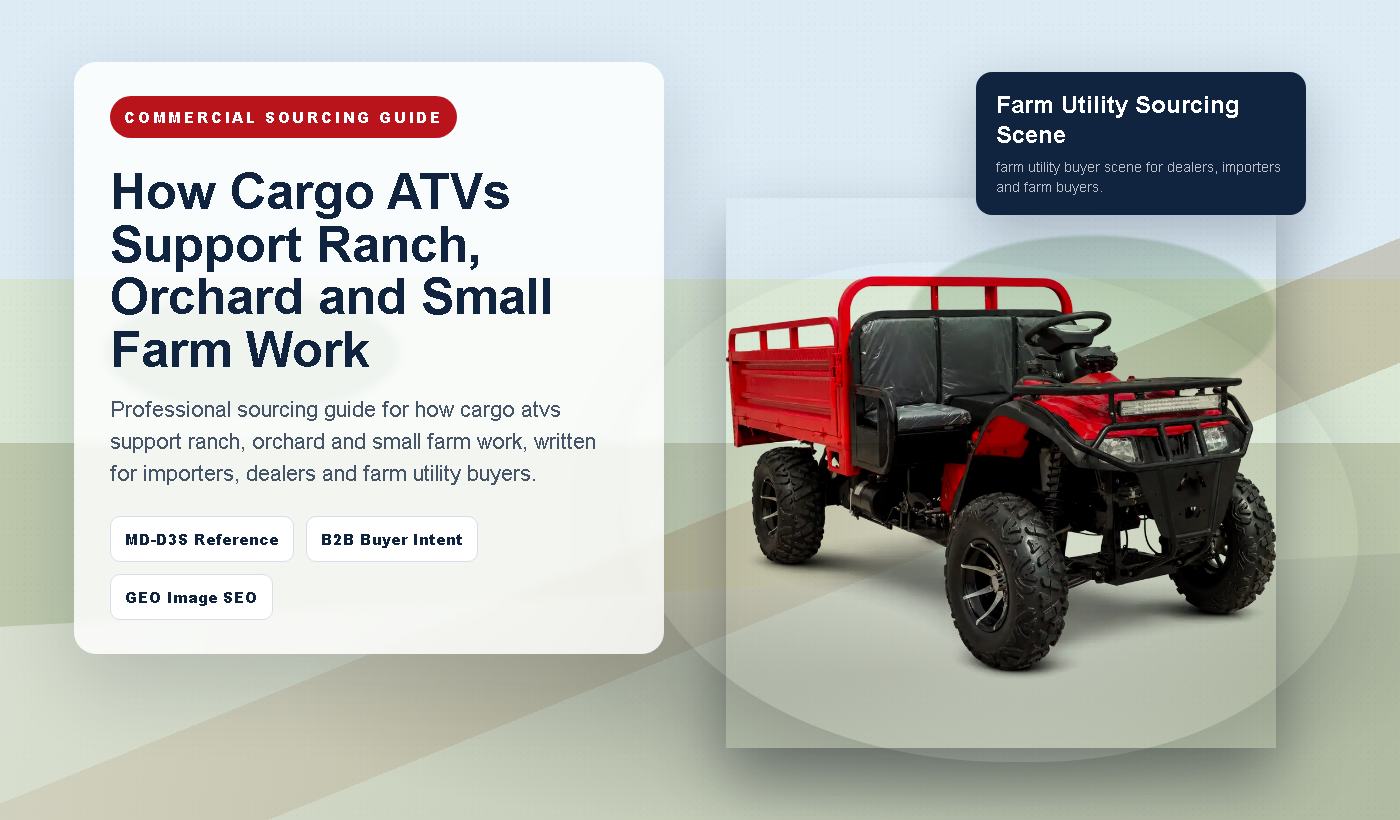
How Agricultural ATVs Support Ranch, Orchard and Small Farm Work
Agricultural ATV ranch work has moved far beyond weekend recreation. On working ranches, orchards and small farms, an agricultural ATV is a daily-use platform for feeding livestock, checking fences, spraying crops, hauling tools and towing trailers. For importers, dealers and OEM sourcing teams, the buying decision starts with how these machines are actually used in the field. This guide breaks down the most common ATV farm applications and matches each one to the specifications that matter: cargo bed, towing capacity, tires and 4WD.
Why the Agricultural ATV Is a Working Platform, Not a Toy
The ranch utility vehicle segment has grown because small and mid-size operations discovered that a purpose-specified ATV covers most daily chores at a fraction of a pickup's purchase price, fuel cost and turning radius. Most suppliers report that agricultural versions — machines ordered with cargo racks, tow hitches, mud guards and work tires — now account for a significant share of their export volume. Dealers see the same pattern: farmers who once used a quad for recreation increasingly buy it for work.
An agricultural ATV earns its place because it is narrow enough to pass through gates and row ends, light enough to avoid rutting pasture, and quiet enough not to spook livestock. It also reaches places a full-size truck cannot: fence lines along creeks, muddy paddock gates, orchard middles and vineyard terraces. When the day's work is spread across hundreds of hectares, the time saving is the real return on investment.
Core Agricultural ATV Ranch Work: Six Applications That Define the Spec Sheet
The spec sheet you send to a supplier should be written backwards — from the jobs the machine must do. Here are the six farm applications that drive most agricultural ATV purchases, with the equipment implications of each.
1. Feeding Hay, Grain and Mineral Blocks
Feeding is the anchor task for most ranch ATVs. A typical routine: load a rear cargo bed with two or three hay bales or a few bags of grain, ride to each paddock or pen, and drop feed while doing a visual check of the herd. For this work, a mid-to-large utility ATV with a rear cargo bed of 150-300 kg is the sweet spot. Towing matters too, because many operators pull a small feed cart rather than carrying everything on the machine. Look for a factory hitch, a bed that tilts or removes easily for cleaning, and grab rails that keep loads from shifting on rough ground.
2. Daily Livestock Checks and Herd Movement
On a ranch, the daily check is non-negotiable: count the herd, look for lameness, injury or calving issues, and move animals between pastures. A quiet, low-slung ATV lets you do this without stirring up cattle. Operators favor 4WD for muddy gateways and wet paddocks, and many fit a low windshield and mirror set for winter checks. For herd movement, the ATV replaces a horseback or on-foot approach: slow-speed throttle response and a robust brake system matter more than top speed. This is one task where a mid-size 400-500cc machine is often preferred over a heavy 800cc model, because it is easier to stop and manoeuvre in tight yards.
3. Fencing and Pasture Maintenance
Fencing season is brutal on equipment. Post drivers, wire rolls, staple boxes, insulators and tools all travel in the bed; a trailer often carries the post driver and strainers. An ATV shines because it can idle along a fence line that a truck cannot reach, and because the cargo bed keeps tools organized between posts. For fencing work, spec a machine with a large flat bed or heavy-duty front rack, all-terrain tires for wet pasture, and a hitch rated for the trailer you will pull. Some operators fit a rear seat or carrier box so a second worker can ride along — worth confirming with your supplier as a factory option.
4. Spraying Orchards, Vineyards and Row Crops
Spraying is where the orchard ATV earns its keep. Many small orchard and vineyard operators mount a 100-400 litre tank with a boom or hand lance on the rear rack or a towed sprayer, and work rows that are too tight for tractor sprayers. The machine's low ground pressure limits compaction between rows, and its narrow width lets it work close to trunks and vines. For spraying, the priorities are a sturdy rack that can carry a full tank without flexing, turf or low-pressure tires that do not rut the row middles, and a transmission that holds a steady low speed. Tank weight changes handling, so a wider stance and adequate rear suspension are worth specifying.
5. Hauling Tools, Harvest and Farm Supplies
The small farm ATV is a general freight handler. It moves bags of fertilizer, buckets of fruit, pruning gear, water containers, tools and daily supplies from the shed to the field and back. Hauling is a bed-and-suspension question: look for a cargo bed rated at least 200 kg, heavy-duty racks, and a suspension tuned for load rather than sport handling. Operators who carry liquids or fruit prefer beds with drain holes and a washable surface. If harvest crates are part of the routine, confirm bed dimensions against your crate sizes before ordering — one of the most common spec mismatches dealers see.
6. Towing Carts, Spreaders and Trailers
Towing turns an ATV into a small tractor. Typical ranch trailers — feed carts, lime and fertilizer spreaders, utility trailers, water tanks — weigh well within an ATV's capability, provided the hitch rating is matched to the load. For towing, the numbers that matter are the manufacturer's tow rating at the tongue, not the engine size alone. A heavy utility ATV in the 600-800cc class with a 500-1000 kg tow rating covers most spreader and trailer work. Fit a ball hitch that matches your trailers, and remember that towing on slopes and soft ground pulls the rating down — 4WD and a rear differential lock help where it is slippery.
Vineyard and Orchard Row Work: The Specialist Case
Vineyard row work deserves its own mention because it changes the spec. Rows are narrow, often 2-3 metres, and vines are low; a standard wide ATV can damage canopies and compact soil. Operators in this segment favor compact machines, narrow tracks, turf or low-pressure tires, and careful low-speed control. Spraying, sucker removal, canopy management and grape hauling are the core jobs. For buyers serving vineyard customers, the practical question is whether a standard machine with narrow tires and a spray kit covers the need, or whether a true narrow-width model is required. Most suppliers offer both; specifying the row width in your order avoids costly mismatches.
ATV Farm Applications and Recommended Specs: Comparison Table
The table below condenses the guidance above into a sourcing reference. Figures are typical industry ranges; confirm exact ratings with your supplier.
| Farm Application | Recommended ATV Class | Cargo Bed | Towing Capacity | Tires | Drivetrain |
|---|---|---|---|---|---|
| Daily livestock checks | Mid-size, 400-500cc | 100-200 kg | 300-500 kg | All-terrain, 25-27 in | 4WD recommended |
| Feeding hay and grain | Utility, 450-700cc | 150-300 kg | 400-600 kg | All-terrain | 4WD |
| Fencing and pasture work | Utility with racks | 150-250 kg | 400-600 kg | All-terrain, wet-ground tread | 2WD acceptable on flat ground |
| Spraying orchard rows | Utility with spray kit | 100-200 kg plus tank | 300-500 kg | Turf or low-pressure | 4WD for hilly blocks |
| Hauling harvest and supplies | Utility, 500-700cc | 200-400 kg | 500-800 kg | All-terrain | 4WD |
| Towing spreaders and trailers | Heavy utility, 600-800cc | 150-300 kg | 600-1000 kg | All-terrain, wider footprint | 4WD with diff lock |
| Vineyard row work | Compact, 300-500cc | 60-150 kg | 200-400 kg | Turf, narrow, low-pressure | 2WD sufficient on firm rows |
Specs That Matter When You Buy Agricultural ATVs
Four specifications dominate every farm-use conversation. Getting them right at sourcing time is cheaper than correcting them after shipment.
Engine Size and Transmission
Most farm applications sit comfortably in the 400-700cc range. Mid-size machines are lighter, easier to handle and cheaper to run; large-displacement machines pull heavier loads and hold speed better on hills. Continuously variable transmissions are the norm, but check for a low-gear or low-range setting, because spraying and livestock work demand slow, steady speeds. Electric models are entering the segment for indoor and noise-sensitive work, but range and charge time still limit them to lighter duties on most farms.
Cargo Bed and Rack Capacity
The bed is the machine's toolbox. Confirm the rated capacity in kilograms, the physical dimensions against the loads you carry, and whether the bed tilts, dumps or removes for cleaning. Front and rear racks extend carrying capacity but change handling when loaded, so verify the manufacturer's total payload, not just the bed rating.
Towing Capacity and Hitch
Towing ratings vary widely within the same engine class, so read the spec sheet, not the marketing copy. Confirm both the total towed weight and the tongue weight, and check what hitch hardware ships as standard — a bare receiver can turn a farm-ready machine into a parts-list project. Remember that ratings assume level ground; slopes, mud and soft orchard soil all reduce effective capacity.
4WD, Differential Lock and Ground Clearance
Four-wheel drive is the single most requested feature in agricultural ATV ranch work, and for good reason: wet paddocks, creek crossings and muddy gateways stop 2WD machines quickly. A front differential lock or selectable locking rear diff adds real capability in mud and on hills. Ground clearance of 25-30 cm keeps the sump and driveline clear of stumps and ruts, while a wider stance improves stability with a loaded bed or trailer.
Tires: All-Terrain, Turf and Low-Pressure
Tire choice is a use-case decision. All-terrain tires suit mixed ranch work and wet ground; turf tires protect orchard and vineyard floors and lawns; low-pressure options reduce compaction and improve ride comfort in row crops. If one machine must do everything, all-terrain rubber at moderate pressure is the safest default, with the supplier's alternate tire package as a drop-ship option for customers with specific crops.
Work Accessories
The accessories list is what turns a recreational quad into an agricultural ATV: tow hitches and ball mounts, spray tanks and booms, rear seats, windshields, mirror kits, tool boxes, plow and blade mounts, and brush guards. When sourcing, ask which accessories are factory-fitted, which are dealer-fit, and how accessory mounting points are reinforced on the frame. Accessory compatibility is a leading cause of post-sale friction, and a clear options list protects your margin.
Sourcing Agricultural ATVs: What B2B Buyers Should Confirm
For importers, dealers and OEM teams, the field applications above translate into sourcing decisions. Start with a specification sheet built from your customers' dominant use cases, then confirm with the supplier: typical export lead times of 30-60 days for standard configurations, longer for custom accessories; minimum order quantities and whether mixed configurations count toward them; spare parts availability; and the documentation package — owner's manuals, parts lists and service guides — in your market's language.
Certification and compliance should be settled before production, not at the port. Emissions and safety requirements differ by destination market, and a machine built for one region may need modifications for another. Ask for the compliance documents your market requires, and request pre-shipment inspection or sample testing on the first order. Dealers consistently report that the cheapest mistakes to fix are the ones caught before the container loads.
Agricultural ATV FAQ
Can one ATV handle both ranch and orchard work?
Yes, with a compromise. A mid-size 4WD utility ATV in the 450-600cc class with all-terrain tires, a 200 kg bed and a 500 kg tow rating covers feeding, fencing, hauling and towing, and still fits most orchard rows. Orchards with very narrow rows or delicate floor management may need a dedicated compact model with turf tires, which is why many dealers stock both configurations.
What engine size should a small farm ATV have?
For general small farm and orchard duty, 400-550cc is the practical sweet spot: enough power for loaded beds and light trailers, light enough to handle easily in yards and rows. Farms doing heavy towing or steep-terrain work should step up to 600-800cc machines, while operations on flat ground with light duties can run 300-400cc machines at lower cost.
Do I need 4WD for farm use?
For most ranch and small farm applications, yes. Muddy gateways, wet paddocks and slopes are routine, and 4WD is what keeps the workday moving. Buyers serving flat, dry operations can offer 2WD as a budget option, but the majority of farm buyers will ask for 4WD first.
What towing capacity is enough for farm trailers?
A 500 kg tow rating covers feed carts, small spreaders and utility trailers; 600-1000 kg covers larger spreaders, water tanks and loaded harvest trailers. Match the rating to the heaviest trailer the customer actually pulls, and remember that slopes and soft ground reduce effective capacity.
Which tires are best for orchard ATV work?
Turf or low-pressure tires suit orchard floors, vineyard rows and lawn areas; all-terrain tires suit mixed ranch work with mud and rough pasture. If one machine serves both, all-terrain tires at moderate pressure are the practical default.
How should importers evaluate agricultural ATV quality before ordering?
Verify the frame and rack construction, the rated payload and tow figures, the suspension components and the spare parts availability. Request a pre-shipment inspection or a sample unit, confirm the documentation package and compliance paperwork for your market, and build spare-parts stocking into the deal. Testing one unit before committing to container volume is the industry-standard safeguard.
Agricultural ATV ranch work is no longer a niche: it is the use case that defines the spec. When feeding, fencing, spraying, hauling and row work are matched to bed capacity, tow rating, tires and drivetrain, the right machine sells itself — and the buyer gets a tool that pays for itself in the first season.