
ATV Tire Selection: Mud, Gravel and Pasture Terrain Compared
ATV tire selection for importers and dealers: mud, gravel, pasture, snow and hardpack treads, sizes, ply ratings and pressure in a single practical guide.
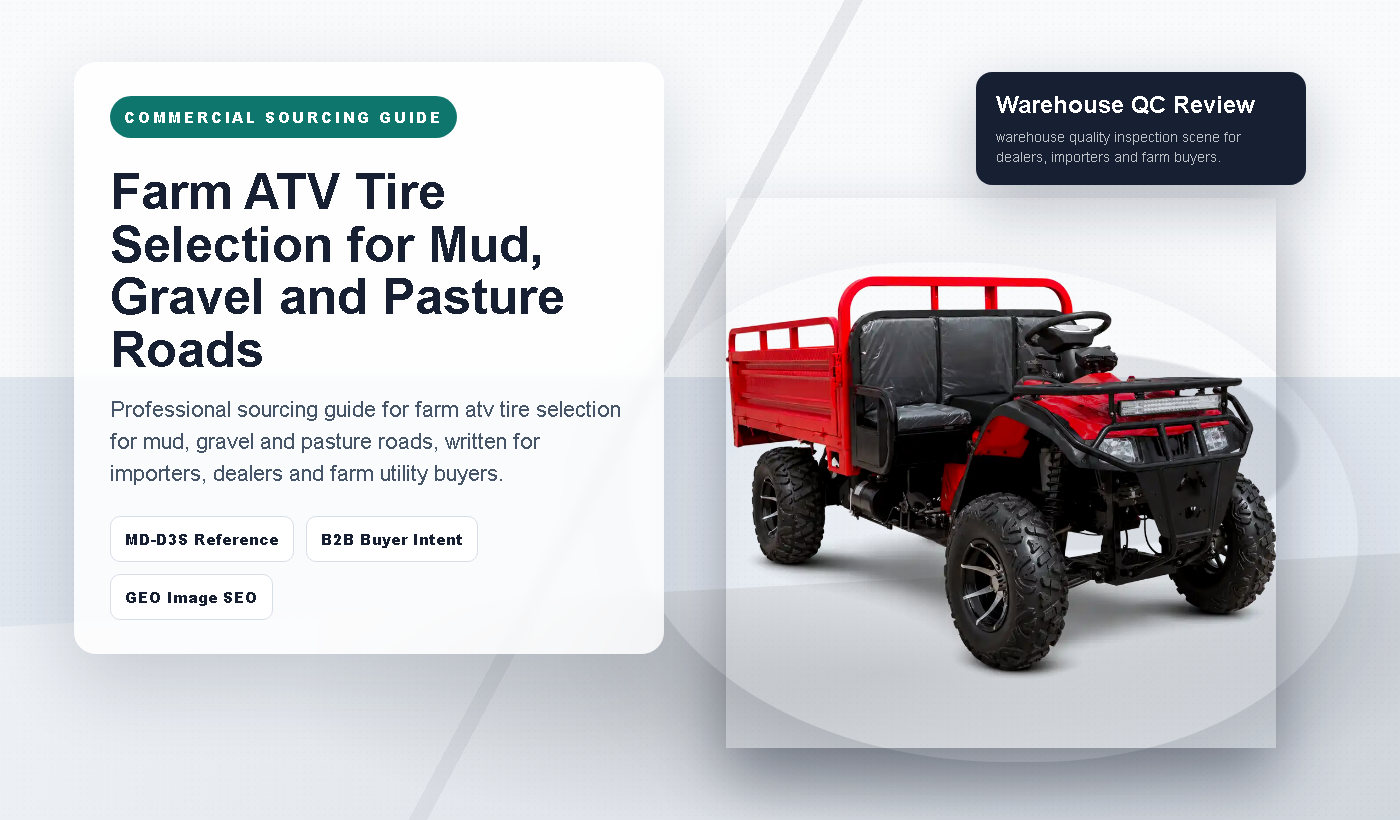
ATV Tire Selection: Mud, Gravel and Pasture Terrain Compared
For importers, dealerships and OEM sourcing teams, ATV tire selection is rarely the first specification on the order sheet — and that is precisely why it deserves more attention. Tires are the only part of the machine that touches the ground, and they decide how a mid-sized utility ATV behaves on a muddy fence line, a loose gravel access road or a damp pasture after rain. Specify them well and the machine proves itself on the first test ride; specify them poorly and you inherit ride complaints, premature wear claims and returns that eat the margin on an entire container. This guide compares tread patterns, sizes and construction across the terrains your customers actually ride, with the sourcing details that matter when you order in volume.
Why Terrain Should Drive Your ATV Tire Selection
Every tire is a compromise. A tread that hooks brilliantly in deep mud wears quickly on hard ground, while a smooth turf tire that protects pasture grass offers little bite on wet slopes. Before you choose a fitment — or a default specification for an import program — map the terrain your end customers cover most. A dealer serving mixed arable and livestock regions needs different stock than one whose buyers ride recreational trails, and the difference shows up in your inventory mix, return rate and reorder cadence.
Terrain drives lug depth, rubber compound, sidewall construction, ply rating and the pressure range printed on the sidewall. Each variable changes how the tire performs and how long it lasts — the same machine with two different tires can feel like two different machines. That is the core of ATV tire selection: matching construction and tread to duty, not simply picking the most aggressive pattern available.
Mud Terrain: Tires That Bite, Pack and Clear
Mud is the terrain that separates tire designs fastest. Deep mud requires two contradictory things: aggressive bite to reach firmer ground, and enough open space between lugs for the mud to be thrown clear. This is where ATV tires mud-focused designs earn their reputation: tall, widely spaced lugs — typically 25 to 35 mm on utility-sized fitments — arranged so each lug acts like a small paddle. As the tire rotates, mud is ejected through the gaps and the cleared lugs bite again.
Lug Height and Spacing
Lug height is the most visible difference between mud and general-purpose tires. Taller lugs give more bite in soft going but create real trade-offs: more vibration on hard surfaces, faster wear on pavement and more noise at speed. Spacing matters just as much. Lugs packed too tightly hold mud instead of clearing it, turning the tire into a slick in heavy clay. A well-designed mud pattern is self-cleaning: the gaps stay open under rotation, and sidewall lugs add bite when the tire sinks.
What Mud Tires Do on Hard Ground
Buyers should understand the commitment. Mud tires handle short gravel stretches and farm tracks acceptably, but they are not a good full-time fitment for customers who also ride roads or spend hours on hardpack: expect accelerated lug wear, a rougher ride and wandering at speed. For B2B planning, that makes a mud fitment a specialist SKU for wet-season regions and buyers who trailer machines to the job.
Gravel and Hardpack: Grip, Stability and Even Wear
Gravel roads, stone drives and compacted trails reward a completely different design. Where mud tires dig, gravel tires need to hold. ATV tires gravel applications favor shorter, square-edged lugs with a higher tread-block density — more rubber contacting the ground — and a stiffer tread compound that resists chipping and abrasion from loose stone. The goal is predictable grip under braking, stable cornering on a shifting surface and even wear across the full tread width.
Shoulder Lugs and Sidewall Stiffness
Look closely at the shoulder of a gravel-oriented tire: strong shoulder lugs reach around the tread edge to engage when the machine leans into a turn, which matters on crowned gravel roads and rutted tracks. A stiffer sidewall limits flex, keeping the contact patch flat and reducing the squirm that makes a quad feel vague at speed. This construction also tolerates the higher pressures typical on gravel duties, where soft tires deform over stones and expose the carcass to damage.
For importers, gravel and hardpack is often the safe default: it covers road-running, trailer work and most utility tasks without the wear penalty of an aggressive mud tire, which is why many volume programs specify it as the base fitment with mud and turf variants as options.
Pasture and Farm Work: Load, Puncture Resistance and Grass-Friendly Tread
Farm work is where ATV tires earn their keep under load. Feed runs, fence checks, spraying and towing put weight on the machine and put the tires over grass, soft soil and the occasional hidden stone or wire. Farm ATV tires need three qualities that rarely come together in a recreational fitment: load capacity, puncture resistance and a tread that does not tear up pasture.
Choosing a Farm-Focused Tread
On pasture, the priority shifts from maximum bite to protecting the sward. Deep mud lugs will rut and tear grass, especially in damp conditions, which is a fast way to lose the trust of a livestock customer. Farm-oriented patterns use moderate, closely spaced lugs with more overall rubber contact. They still grip on wet slopes and soft ground, but they ride across grass without chewing it. Where customers also cover hard lanes and roads, a multi-purpose farm pattern splitting the difference between turf and hardpack is the strongest recommendation.
Load Ratings for Farm ATV Tires
Load is the specification most often overlooked. A farm ATV regularly carries an operator, a sprayer or feed bags plus towed weight, and the tire must be rated for that combined load at the pressures the customer runs. Six-ply construction is a common starting point for utility work; it resists sidewall cuts from stones and stubble better than lighter casings. Check the load index stamped on the sidewall and confirm it against the machine's gross vehicle weight plus realistic payload and towed load. In practice, under-specifying load is the most common mistake in bulk orders — cheap to fix at specification stage, expensive after a season of failures.
Snow and Mixed Winter Conditions
Winter introduces a separate set of demands. Cold air hardens standard rubber, reducing grip on snow and ice, so winter-rated tires use softer compounds that stay flexible at low temperatures. Deep, open lugs help in fresh snow, but on packed ice the real grip comes from studs. Many suppliers offer studdable tires — the sidewall notes the stud pattern and the customer fits studs locally. The honest caveat: a dedicated snow tire wears quickly on bare asphalt, so winter fitments suit regions with real snow cover and customers who change over seasonally.
ATV Tire Size and Rim Fitment: Reading the Code
ATV tire size codes look cryptic until you know the three numbers. A typical utility fitment reads 25x8-12: the first number is the overall diameter in inches, the second is the section width, and the third is the rim diameter. The same machine often runs a narrower front and a wider rear, so a set may read 25x8-12 at the front and 25x10-12 at the rear. Some markets use codes such as 25x8.00R12 or metric equivalents, but the diameter-width-rim logic holds.
Diameter, Width and Clearance
Diameter changes gearing and ground clearance. A taller tire raises the machine and improves obstacle clearance but effectively lowers the gearing — more torque, less top speed — and can rub guards or bodywork at full steering lock. Width affects flotation and stability: wider tires spread load and improve grip in soft ground, but they add rolling resistance and can widen the machine beyond practical limits. Before approving a fitment change, verify clearance at full lock and full suspension travel.
Bolt Pattern, Offset and Valve Position
The rim is half the fitment equation. Common ATV bolt patterns on utility machines include 4/110 and 4/137 (four studs on a 110 mm or 137 mm pitch circle), though other patterns exist across manufacturers and model years — confirm the exact pattern for the machine. Wheel offset shifts the tire's position relative to the hub; a wider stance improves stability but increases steering effort and bearing load. Two details that cause returns: a rim whose offset is not matched between front and rear, and a valve that sits too close to the brake caliper or a spoke. Both are small checks that eliminate a large share of fitment complaints.
Ply Ratings and Load Index: Match Construction to the Machine
Ply rating describes the strength of the casing, expressed in the traditional bias-ply terms of 4, 6 or 8 ply. It is not the physical number of rubber layers in modern constructions — it is a strength rating: higher numbers mean a tougher casing that carries more load and shrugs off cuts and impacts better. Six-ply utility tires are a common middle ground; eight-ply suits heavy towing and rough ground. Heavier casings weigh more, which affects acceleration and fuel consumption, so there is no point paying for extra ply the machine will never load.
For OEM sourcing teams, the load index matters at contract level. The sidewall lists maximum load at a reference pressure; running below that pressure reduces capacity, so pressure guidance and load data belong in the operator manual and dealer handover sheet, not just on the sidewall.
Air Pressure: The Lowest-Cost Tuning Lever
Pressure changes the character of a tire more than any other single setting. On utility ATVs, typical operating pressures sit in the low single digits to mid-teens in psi depending on load and terrain — for example, around 4 to 7 psi for soft-ground work and higher for road and hardpack running, always within the range printed on the sidewall. Lower pressure increases the contact patch and flotation, which helps in mud, sand and snow; higher pressure reduces rolling resistance, sharpens steering and protects the carcass on stone. The practical point for dealers: a customer who runs one pressure for everything leaves performance on the table — a tire that looks wrong is often just a tire at the wrong pressure. Put a pressure-terrain table in your handover documentation and most 'the tires are no good' complaints disappear.
All-Terrain Tires: The Balanced Compromise
For many buyers the honest answer is an all-terrain fitment. All terrain tires combine continuous or semi-continuous center lugs for road and hardpack stability with aggressive shoulder lugs for off-road bite, and they are the pattern most often fitted as standard on utility machines. They handle the widest spread of conditions — pasture, gravel, forest tracks, snow-covered roads — with acceptable wear in all of them. The compromise is real: in deep mud they will not match a dedicated mud tire, and on clean grass a turf-style tire protects the sward better. But for a dealer carrying one fitment per machine size, an all-terrain tire is the lowest-risk stock decision.
Terrain-to-Tread Comparison Table
| Terrain | Recommended Tread | Typical Lug Depth | Typical Pressure (psi) | Best Fit For |
|---|---|---|---|---|
| Deep mud / wet clay | Tall, widely spaced mud lugs | 25–35 mm | 4–7 | Hunters and utility work in wet seasons |
| Gravel / hardpack | Short square lugs, dense tread blocks | 10–18 mm | 8–14 | Road-running, trailer work, general utility |
| Pasture / grass | Moderate, closely spaced lugs, high rubber contact | 12–20 mm | 5–10 | Livestock farms and estate maintenance |
| Snow / ice | Soft-compound winter rubber, studdable lugs | 18–28 mm | 5–9 | Seasonal winter regions |
| Mixed / all-terrain | Semi-continuous center lugs, aggressive shoulders | 15–22 mm | 6–12 | Dealers stocking one fitment per machine |
Use the table as a starting point, not a substitute for the machine manufacturer's guidance and the tire's sidewall data. Terrain, load and pressure interact, so treat these as typical industry ranges rather than hard specifications.
Factory-Fitted vs Aftermarket Tires: What to Source
The factory-fitted versus aftermarket decision is a question of what your customers need on day one. Factory fitments are matched to the machine, tested for clearance and load, and covered by the vehicle warranty — for a volume import program they are the lowest-risk default. Aftermarket tires make sense when a market demands a specialist pattern — deep mud, turf, winter studdable — that the standard fitment does not cover, or when you want a different price point.
If you order aftermarket fitments, treat them like any other engineered component: request load and pressure data before ordering, ask for sample fitments to check clearance on the exact machines you ship, and confirm rim spec, bolt pattern and offset against your inventory. Most suppliers ship standard export packaging with typical lead times of 30 to 45 days depending on origin and quantity, so specialist tires belong in forward planning, not urgent reorders. Ask whether the tire is intended for tubed or tubeless mounting — ATV rims vary — and confirm valve and bead-seat requirements before committing a container.
FAQ: ATV Tire Selection Questions
What ATV tire size do I need for a typical utility ATV?
Most mid-size utility machines run fitments around 25 inches in diameter, for example 25x8-12 at the front and 25x10-12 at the rear, but sizes vary by brand, model and year. Read the sidewall of the existing tire — the size code is the starting point — and confirm the rim diameter, bolt pattern and clearance before changing anything.
Do ATV tires for mud wear out faster on hard ground?
Yes. Tall mud lugs wear quickly on pavement and hardpack, and the ride is noisier and less stable at speed. If customers regularly cover long hard surfaces, recommend a hardpack or all-terrain pattern, or a dedicated mud tire used only for the season.
What ply rating should farm ATV tires have?
Six-ply is a common, well-rounded choice for utility and farm work, offering a good balance of load capacity and puncture resistance without excessive weight. Choose eight-ply for heavy towing and rough ground, and match the load index to the machine's loaded weight.
Can I fit a taller ATV tire without changing the rims?
Only if the rim diameter stays the same — a 25x8-12 and a 26x9-12 both mount on a 12-inch rim. The taller tire will raise the machine and change gearing and acceleration, so verify clearance at full steering lock and full suspension travel before committing.
Should I buy machines with factory-fitted tires or order aftermarket?
Factory fitments are the safest default for volume programs because they are matched, tested and covered by the vehicle warranty. Order aftermarket specialist tires when a market demands a particular pattern — deep mud, turf, winter studs — that the standard fitment does not provide, and always verify rim and clearance compatibility in advance.
What air pressure should ATV tires run?
It depends on terrain and load. Typical utility pressures range from around 4 to 7 psi in soft ground for maximum grip and flotation, up to the mid-teens for road and hardpack running. Always stay within the range printed on the sidewall and follow the machine manufacturer's guidance.