
What Is the Difference Between an ATV and a Four-Wheeler, and What Should Buyers Know Before Purchasing?
If you are shopping for an off-road vehicle, you may notice that the terms ATV and four-wheeler are often used interchangeably. This can make the buying process confusing, especially for first-time buyers comparing utility ATVs, recreational quad bikes, farm ATVs, and other off-road vehicles.
If you are shopping for an off-road vehicle, you may notice that the terms ATV and four-wheeler are often used interchangeably. This can make the buying process confusing, especially for first-time buyers comparing utility ATVs, recreational quad bikes, farm ATVs, and other off-road vehicles.
So, what is the difference between an ATV and a four-wheeler?
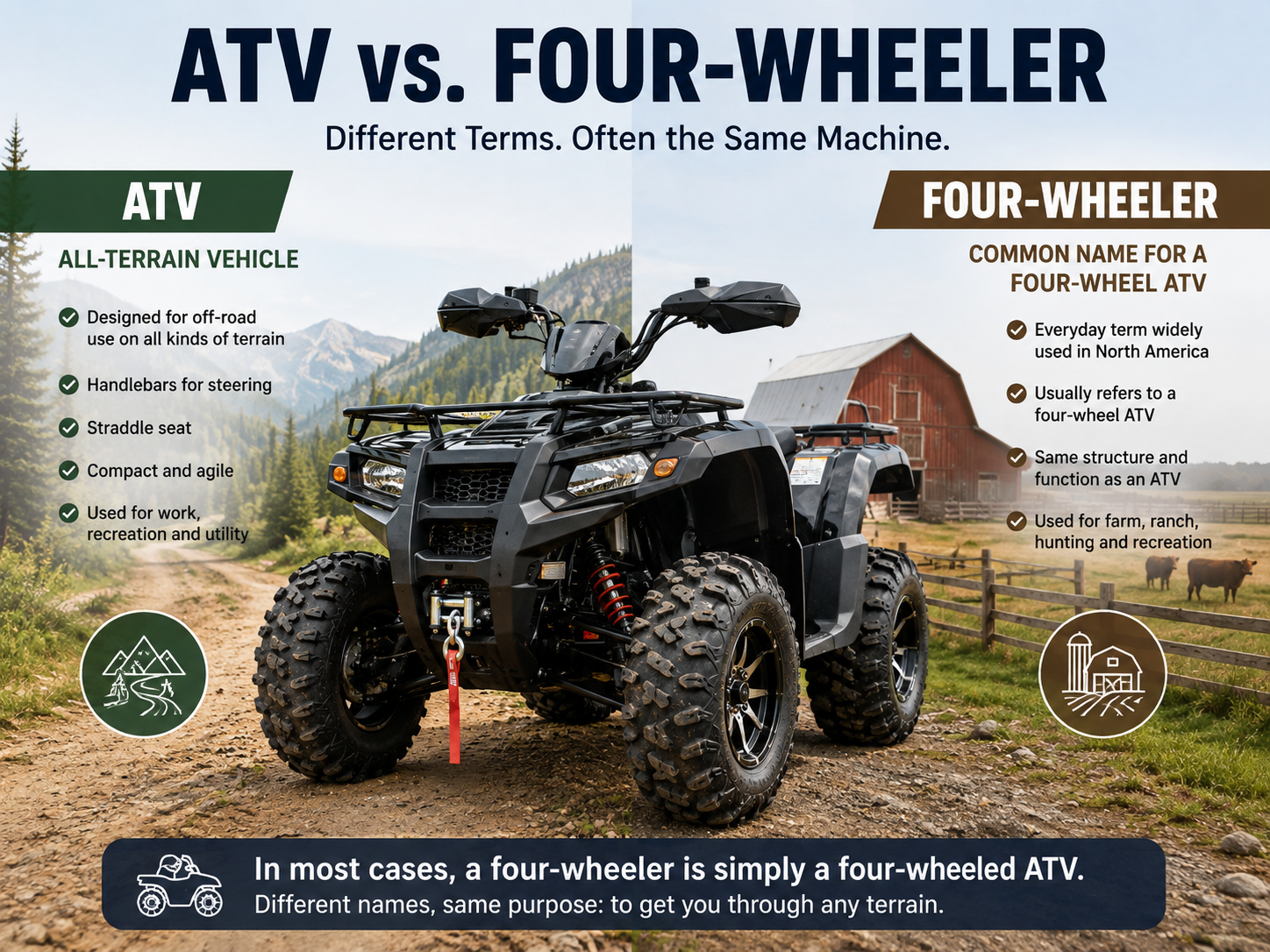
In everyday conversation, a four-wheeler usually refers to a four-wheeled ATV. However, ATV is the broader and more accurate industry term. ATV stands for All-Terrain Vehicle, while “four-wheeler” is an informal name commonly used for an ATV with four wheels.
For most consumers, the distinction is less important than choosing the right vehicle for the intended use. Whether you need an ATV for farm work, ranch maintenance, hunting, trail riding, outdoor recreation, or commercial applications, factors such as engine size, 2WD or 4WD, suspension, cargo capacity, towing ability, tires, braking, and after-sales support matter far more than the terminology.
This ATV buying guide explains the difference between an ATV and a four-wheeler and highlights the most important things buyers should know before purchasing.
What Is an ATV?
An ATV, or All-Terrain Vehicle, is a motorized off-road vehicle designed to travel over surfaces that may be difficult for conventional road vehicles.
ATVs are commonly used on:
- Dirt roads
- Farm tracks
- Forest trails
- Gravel
- Mud
- Sand
- Ranch land
- Mountain trails
- Snow-covered terrain
A typical ATV has a straddle-style seat, handlebars for steering, large low-pressure off-road tires, and a compact chassis designed for maneuverability.
Depending on the model, an ATV may also include features such as 4WD, front and rear cargo racks, a winch, independent suspension, LED lighting, passenger backrests, tow hitches, and aggressive all-terrain tires.
Because of this versatility, utility ATVs are popular not only for recreational riding but also for agricultural, hunting, forestry, property management, and commercial applications.
What Is a Four-Wheeler?
The term four-wheeler is an informal expression commonly used in North America to describe a four-wheeled ATV.
In most consumer conversations:
Four-wheeler = four-wheel ATV.
However, the term itself is not as technically precise as ATV.
For example, many vehicles have four wheels, including golf carts, UTVs, side-by-sides, and some utility vehicles. But people generally do not call all of those vehicles four-wheelers.
When someone says:
“I want to buy a four-wheeler for my farm.”
They are usually talking about a utility-style ATV.
Likewise:
“What is the best four-wheeler for hunting?”
usually means:
“What is the best ATV for hunting?”
For product descriptions, supplier catalogs, e-commerce websites, and international sourcing, ATV is usually the better primary term, while “four-wheeler” can be used naturally as a secondary keyword.
ATV vs Four-Wheeler: Is There Really a Difference?
For most buyers, there is no meaningful difference between an ATV and a four-wheeler if both terms refer to the same four-wheeled machine.
The key difference is terminology.
ATV is an industry category.
Four-wheeler is a common nickname.
ATV is also a broader term because the category has historically included different vehicle configurations. In today's market, however, most adult recreational and utility ATVs use four wheels.
This is why searches such as:
- ATV for sale
- four-wheeler for sale
- 4WD ATV
- utility four-wheeler
- farm ATV
- hunting four-wheeler
may all come from buyers looking for very similar products.
Instead of focusing too heavily on the name, buyers should compare the actual specifications and intended applications.
ATV vs UTV: Do Not Confuse the Two
One comparison that matters much more is ATV vs UTV.
An ATV is normally ridden with the operator straddling the seat and controlling the vehicle using handlebars.
A UTV, or Utility Task Vehicle, usually has side-by-side seating, a steering wheel, pedals, a larger body, and often a cargo bed.
ATVs are generally:
- Narrower
- Lighter
- Easier to maneuver
- Easier to transport
- Better suited to narrow trails
- Less expensive than many UTVs
UTVs are generally:
- Larger
- More comfortable for multiple occupants
- Capable of carrying more cargo
- Better suited to some heavy-duty work
- Equipped with automotive-style controls
For farmers, hunters, ranchers, and recreational users who value agility and compact dimensions, a utility ATV can be an excellent option.
What Should You Know Before Buying an ATV?
Choosing an ATV should start with one question:
What will you actually use it for?
A buyer looking for a recreational trail ATV may have completely different requirements from a farmer who needs a utility ATV for daily property maintenance.
Before purchasing, consider the following factors.
1. Decide How You Will Use the ATV
The intended application should determine almost every major specification.
ATV for Farm Work
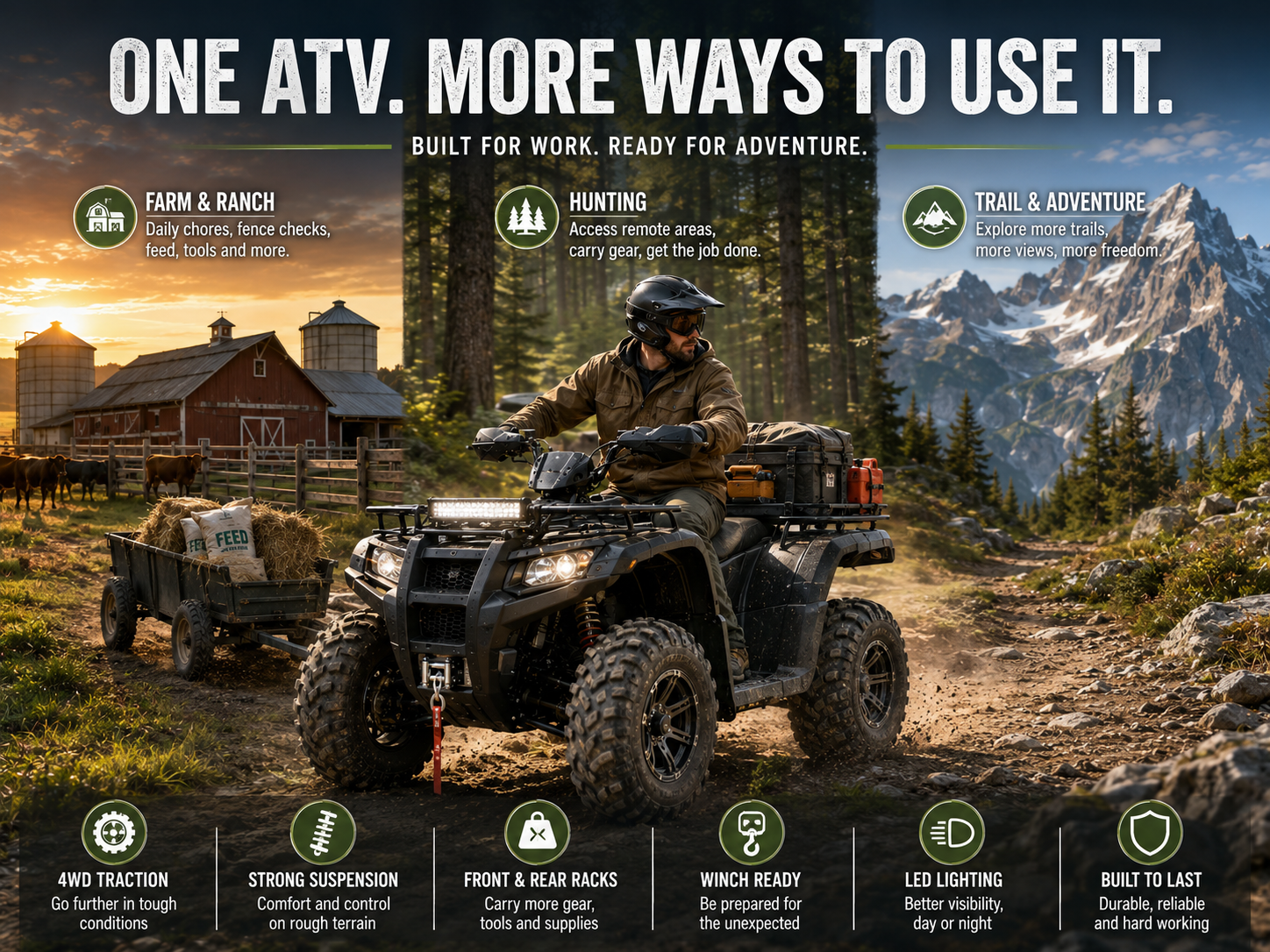
A farm ATV may be used to:
- Inspect fences
- Check livestock
- Carry animal feed
- Transport tools
- Tow compatible equipment
- Move around large properties
- Travel over muddy or uneven farm roads
For these uses, buyers often prioritize low-speed torque, durable suspension, cargo racks, 4WD capability, towing provisions, good ground clearance, and durable tires.
ATV for Hunting
A hunting ATV may need to travel through forest trails, muddy terrain, uneven ground, or remote property.
Useful features may include:
- Front and rear cargo racks
- Winch
- 4WD
- Aggressive tires
- LED lighting
- Good suspension
- Storage capability
Noise, maneuverability, cargo capacity, and reliability may also be important considerations.
ATV for Recreational Riding
For trail riding and weekend outdoor adventures, buyers may place greater emphasis on acceleration, suspension comfort, handling, braking performance, and riding ergonomics.
The best ATV is not necessarily the most powerful machine. It is the ATV that best matches the rider's actual needs.
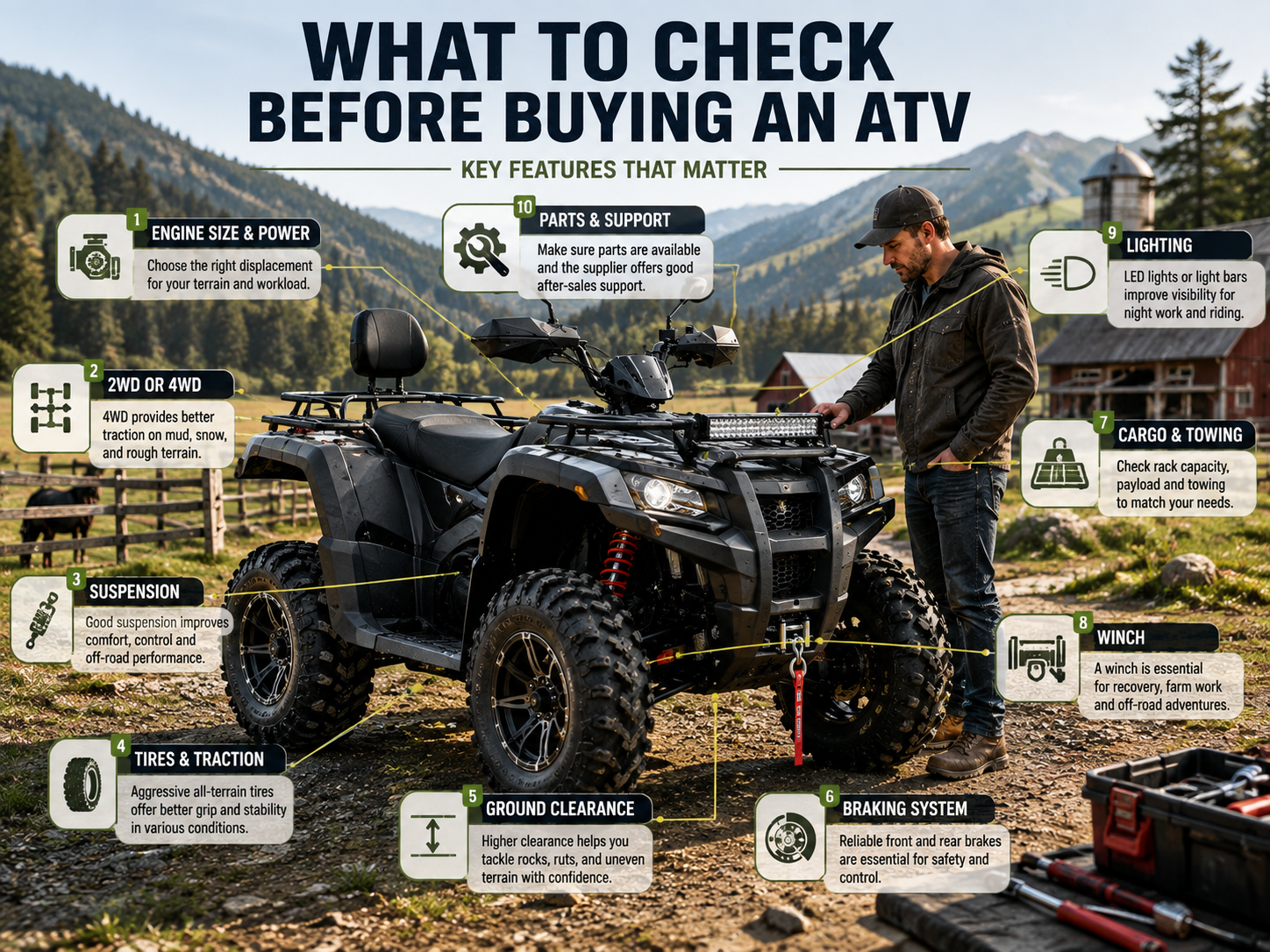
2. Choose the Right Engine Size
Engine displacement is one of the most common factors buyers compare.
ATVs can be available in a wide range of engine sizes. Smaller-displacement machines may suit light recreational use or less demanding tasks, while larger utility ATVs may provide more torque for challenging terrain, carrying loads, or towing.
However, bigger is not always better.
A high-displacement ATV may:
- Cost more
- Consume more fuel
- Be heavier
- Produce more power than a beginner needs
Before choosing an engine size, consider rider experience, terrain, expected workload, vehicle weight, and intended speed.
Buyers should compare actual specifications rather than selecting an ATV based on engine displacement alone.
3. Understand 2WD vs 4WD ATV
One of the most important buying decisions is whether you need a 2WD ATV or 4WD ATV.
A 2WD ATV can be suitable for relatively firm terrain and lighter recreational use.
A 4WD ATV can offer advantages when riding through:
- Mud
- Loose gravel
- Snow
- Steep terrain
- Soft ground
- Rough farm tracks
For farm work, ranch use, hunting, and difficult off-road environments, buyers often prefer 4WD because additional traction can improve capability in challenging conditions.
Some ATV models may also include selectable 2WD/4WD systems or differential-lock functions.
4. Pay Attention to Tires
ATV tires play a major role in traction, handling, comfort, and off-road performance.
Utility ATVs often use wide tires with deep tread patterns to improve grip on loose or uneven terrain.
Different tire designs may be better suited to:
- Mud
- Sand
- Hard-packed trails
- Rocky surfaces
- Snow
- Mixed terrain
Do not assume the largest or most aggressive tire is automatically the best choice. Tire design should match the intended riding environment.
Correct tire pressure is also important because ATV tires commonly operate differently from conventional car tires.
5. Check Suspension and Ground Clearance
A good ATV suspension system helps the tires maintain contact with uneven terrain while improving rider comfort and vehicle control.
When comparing ATVs, consider:
- Front suspension type
- Rear suspension type
- Shock absorber design
- Suspension travel
- Ground clearance
Higher ground clearance may help an ATV pass over rocks, ruts, roots, and uneven ground without easily contacting obstacles underneath the vehicle.
For riders frequently traveling on rough trails, farms, ranches, or forest terrain, suspension quality can be just as important as engine power.
6. Consider Cargo and Towing Requirements
If you are purchasing a utility ATV, cargo capacity may be a key factor.
Front and rear cargo racks can be useful for carrying:
- Tools
- Hunting equipment
- Farm supplies
- Feed
- Camping gear
- Small containers
- Personal equipment
Some ATVs can also tow compatible trailers or accessories.
However, buyers should always check the manufacturer's specified rack capacity, payload capacity, and towing capacity rather than estimating what the machine can handle based on appearance.
Overloading an ATV can affect braking, steering, stability, and suspension performance.
7. Decide Whether You Need a Winch
A winch is a valuable accessory on many utility ATVs.
It can be useful for:
- Vehicle recovery
- Farm work
- Moving certain loads
- Trail recovery
- Hunting applications
- Snow-plow setups on compatible machines
For buyers operating in mud, forests, remote areas, or demanding farm environments, an ATV equipped with a winch can provide additional utility.
8. Check the Braking System
Performance is not only about how fast an ATV can accelerate.
Braking performance matters just as much.
Buyers should check the type and design of the front and rear braking systems and make sure the ATV is appropriate for the expected terrain and workload.
A heavily loaded ATV or a machine used on steep terrain may behave very differently from an unloaded ATV on flat ground.
Good tires, suspension, brakes, and proper rider technique all contribute to vehicle control.
9. Consider Lighting and Night Visibility
For farm inspections, hunting access, ranch operations, and trail riding in low-light conditions, lighting can be an important feature.
An ATV may include headlights, auxiliary lights, or an LED light bar.
Additional lighting can improve visibility, but buyers should consider local regulations and avoid using excessively bright lights in ways that could create hazards for other people.
10. Understand Passenger Capacity
One common mistake is assuming that any ATV with a long seat or rear backrest is automatically designed to carry two people.
That is not always true.
Some ATVs are specifically designed and approved for a passenger, while others are intended for a single rider only.
Buyers should confirm the manufacturer's rated passenger capacity before carrying another person.
This is particularly important for families, tour operators, rental businesses, and recreational buyers.
11. Evaluate Parts Availability and Maintenance
A low purchase price does not necessarily mean low total ownership cost.
Before buying an ATV, ask:
- Are spare parts available?
- Are filters, brake components, belts, tires, and electrical parts easy to source?
- Is there a maintenance manual?
- What warranty is offered?
- Is technical support available?
- Can replacement parts be shipped internationally?
For distributors and commercial buyers, spare-parts support can be especially important.
A reliable ATV supplier should be able to provide clear information about maintenance requirements and replacement components.
12. Check Certification and Local Regulations
ATV regulations differ by country, state, province, and local jurisdiction.
Depending on the market, requirements may apply to:
- Vehicle certification
- Registration
- Age restrictions
- Helmet use
- Public-road access
- Lighting
- Emissions
- Noise
- Insurance
An ATV designed primarily for off-road use should not automatically be assumed to be street legal.
Importers and distributors should verify the certification requirements of the destination market before placing a bulk order.
13. New ATV vs Used ATV
A used ATV may offer a lower purchase price, but its condition must be inspected carefully.
When evaluating a used ATV, check:
- Engine condition
- Cold starting
- Smoke
- Fluid leaks
- Suspension
- Steering play
- Wheel bearings
- Frame damage
- Brakes
- Tires
- CVT or drivetrain condition
- Electrical system
- Maintenance history
A new ATV generally provides clearer specifications, warranty coverage, and less uncertainty about previous use.
For importers, dealers, rental companies, and commercial operators, purchasing new ATVs may also make fleet standardization easier.
14. What Should B2B Buyers Look for in an ATV Supplier?
For wholesale buyers, importers, and distributors, choosing the right ATV manufacturer or ATV supplier involves more than comparing unit prices.
B2B buyers should evaluate:
- Manufacturing capability
- Quality-control procedures
- Model specifications
- Certification options
- OEM and ODM capability
- Minimum order quantity
- Spare-parts supply
- Packaging
- Container-loading efficiency
- Warranty terms
- Technical documentation
- Lead time
- After-sales support
If you are sourcing Chinese ATVs for wholesale, request complete specifications before comparing quotations.
Two machines that look similar in photos can have significant differences in engines, suspension, frame construction, electrical components, brakes, tires, and overall configuration.
ATV Buying Checklist
Before making a final decision, buyers should confirm:
- Intended use
- Engine displacement
- 2WD or 4WD
- Transmission type
- Suspension
- Ground clearance
- Tire specification
- Braking system
- Cargo rack capacity
- Payload
- Towing capacity
- Winch availability
- Lighting
- Passenger rating
- Fuel capacity
- Spare-parts availability
- Warranty
- Certification
- Supplier support
This checklist is especially useful when comparing several ATVs for sale from different manufacturers.
Frequently Asked Questions
Is a four-wheeler the same as an ATV?
In most everyday usage, yes. A four-wheeler generally refers to a four-wheeled ATV. ATV is the broader and more formal industry term.
Is every ATV a four-wheeler?
Not necessarily from a terminology standpoint, although most modern consumer ATVs are four-wheeled vehicles. “Four-wheeler” is an informal term rather than a precise technical classification.
Is an ATV better than a UTV?
Neither is universally better. An ATV is often more compact, maneuverable, and easier to transport, while a UTV generally provides more seating and cargo capacity. The better choice depends on the application.
Is a 4WD ATV worth buying?
For buyers who frequently ride on mud, snow, steep trails, loose surfaces, farms, ranches, or hunting land, 4WD can provide useful additional traction. For lighter riding on firm surfaces, 2WD may be sufficient.
What is the best ATV for farm work?
A utility ATV for farm work typically benefits from durable construction, good low-speed performance, suitable cargo racks, strong suspension, appropriate tires, sufficient ground clearance, and 4WD where terrain requires it.
What should a first-time ATV buyer look for?
First-time buyers should focus on manageable power, predictable handling, braking, correct vehicle size, reliability, parts support, and the intended riding environment rather than simply buying the largest engine available.
Can an ATV carry a passenger?
Only if the specific ATV model is designed and rated for passenger use. A rear seat cushion or backrest alone does not necessarily mean the vehicle is approved for two riders.
Are Chinese ATVs good?
Quality varies by manufacturer and model. Buyers should evaluate specifications, quality control, certification, components, warranty, spare-parts supply, and supplier experience rather than judging all Chinese ATVs as one category.
Final Thoughts: ATV or Four-Wheeler?
When comparing an ATV vs four-wheeler, the terminology is usually simpler than it appears.
A four-wheeler is generally the everyday name for a four-wheeled ATV, while ATV is the more widely accepted product and industry term.
For buyers, the more important questions are:
What terrain will you ride on? What work does the vehicle need to perform? How much power and traction do you need? How much cargo will you carry? Do you need 4WD, a winch, cargo racks, towing capability, or additional lighting?
Answer those questions first, and choosing the right ATV becomes much easier.
Whether you are looking for a utility ATV for farm work, a 4WD ATV for hunting, an off-road ATV for trail riding, or wholesale ATVs for distribution, focus on specifications, application, safety, reliability, parts availability, and supplier support—not just engine size or appearance.
For businesses sourcing ATVs for farm, ranch, hunting, recreation, rental, or distribution applications, comparing complete specifications and supplier capabilities before purchasing can significantly reduce long-term ownership and sourcing risks.
Explore more ATV and off-road vehicle sourcing options at echuntrade.com.