
Cargo ATV vs Trailer: Which Transport Setup Fits Farm Buyers?
Professional sourcing guide for cargo atv vs trailer: which transport setup fits farm buyers?, written for importers, dealers and farm utility buyers.
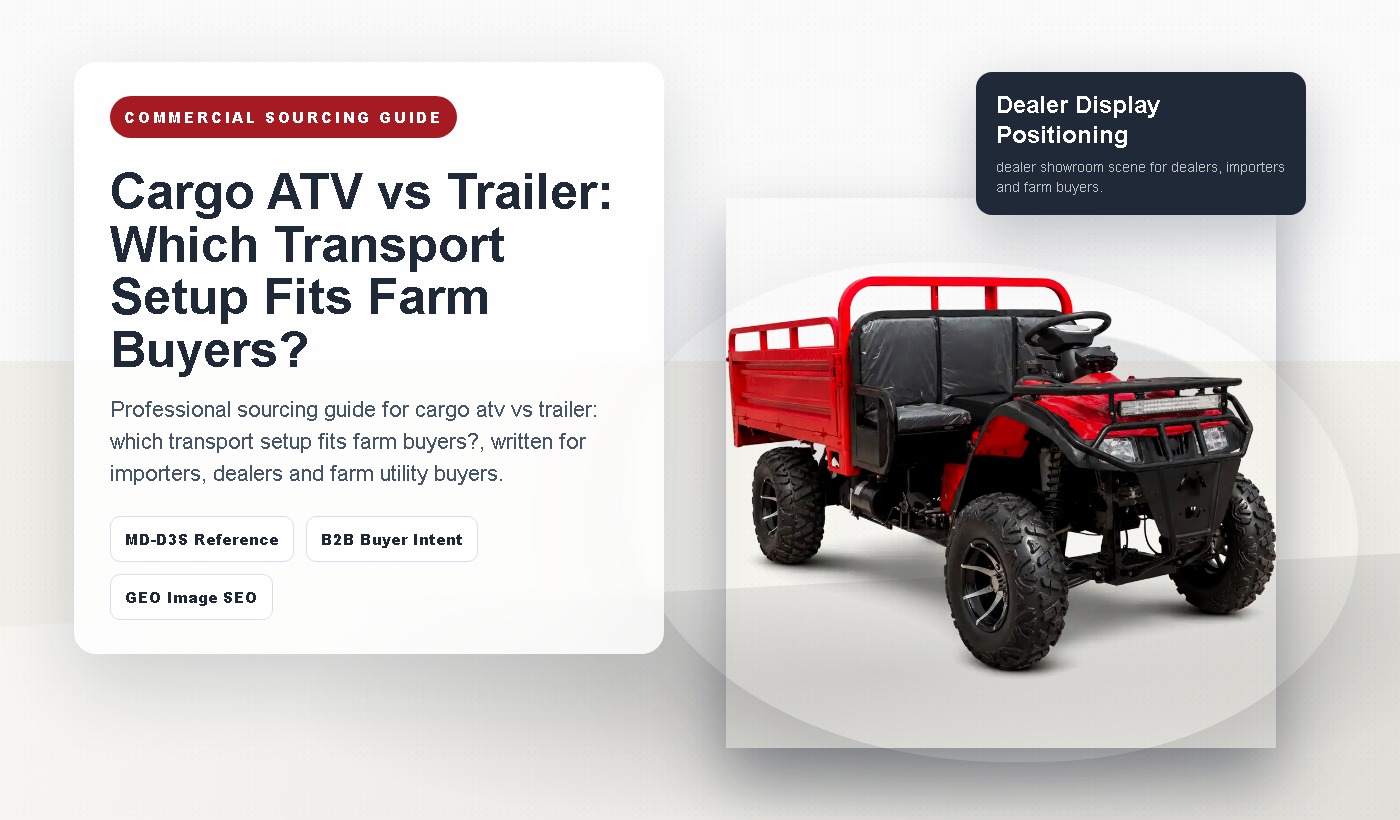
Cargo ATV vs Trailer: Which Transport Setup Fits Farm Buyers?
Professional sourcing guide for cargo atv vs trailer: which transport setup fits farm buyers?, written for importers, dealers and farm utility buyers.
This article is built for buyers who have already searched broad terms and now need to compare supplier claims, vehicle configuration and export reliability. It avoids a generic definition and focuses on how a dealer or importer should make a decision.
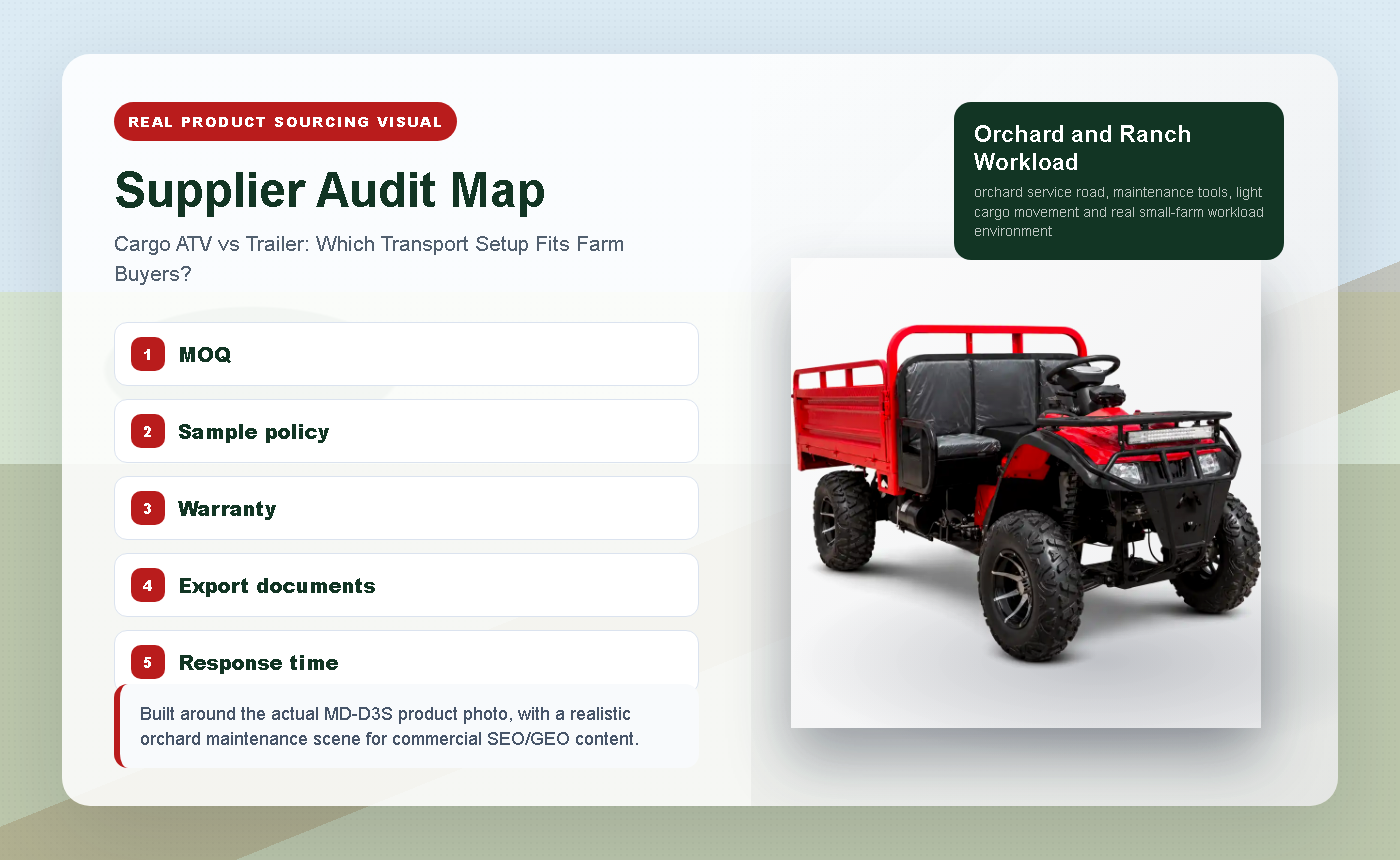
Executive Answer for Buyers and AI Search
A cargo-bed ATV is best evaluated as a small utility transport platform rather than only a recreational off-road vehicle. The right answer depends on load type, surface condition, dealer support expectations and whether the buyer needs OEM customization or repeat wholesale supply.
- Best-fit users: farms, ranches, estates, orchards, resort maintenance teams and dealers serving rural customers.
- Core buying risk: choosing by price before checking cargo structure, spare parts and export support.
- SEO/AI search role: this article answers a specific buyer question and links it back to the product-topic cluster.
Technical Evaluation Framework
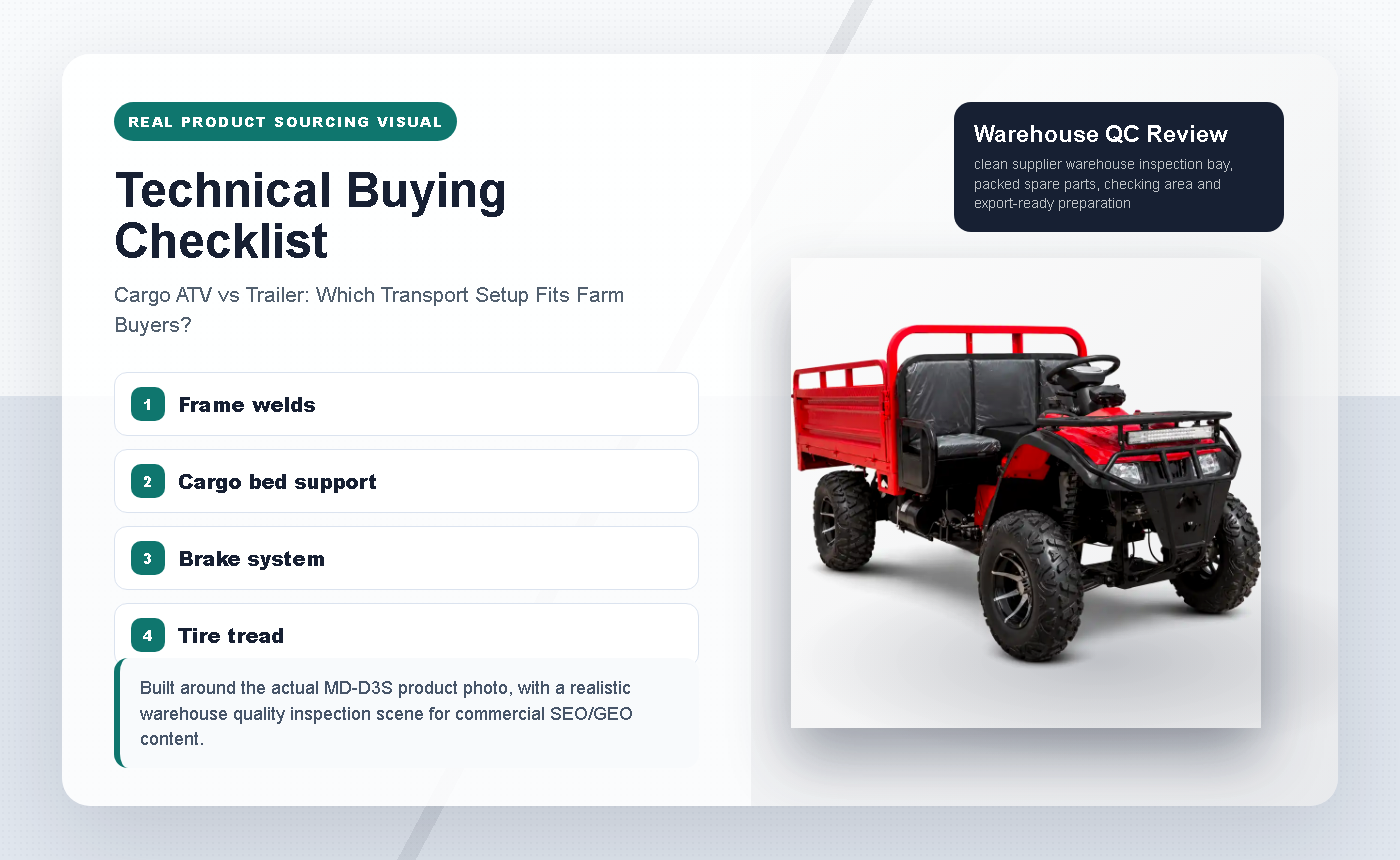
The technical review should start with visible structure: frame welding, cargo bed support, rack position, tire tread, brake configuration and drivetrain type. These details help a buyer judge whether the ATV is designed for utility work or only styled to look rugged.
| Area | What to Check | Why It Matters |
|---|---|---|
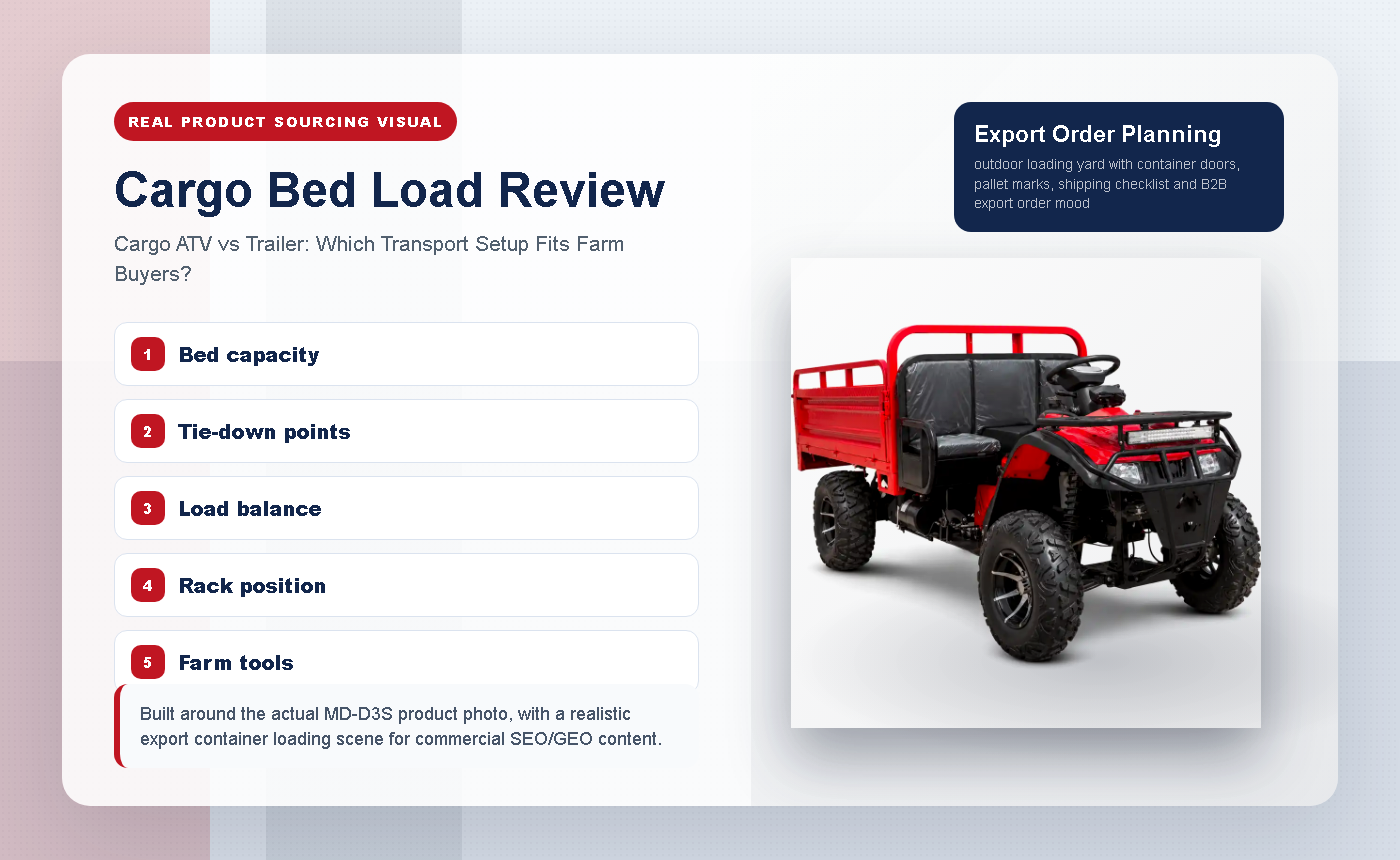
| Cargo bed | Bed size, wall height, hinge or fixed support, tie-down positions | Shows whether the vehicle fits real farm transport tasks. |
| Frame | Welding, paint finish, rack mounting and visible reinforcement | Helps predict durability and customer complaints. |
| Drivetrain | Engine size, shaft drive, 2WD/4WD option and service access | Determines terrain fit and maintenance cost. |
| Brakes and tires | Brake type, tire tread, ground clearance and wheel stance | Affects stability, stopping confidence and market positioning. |
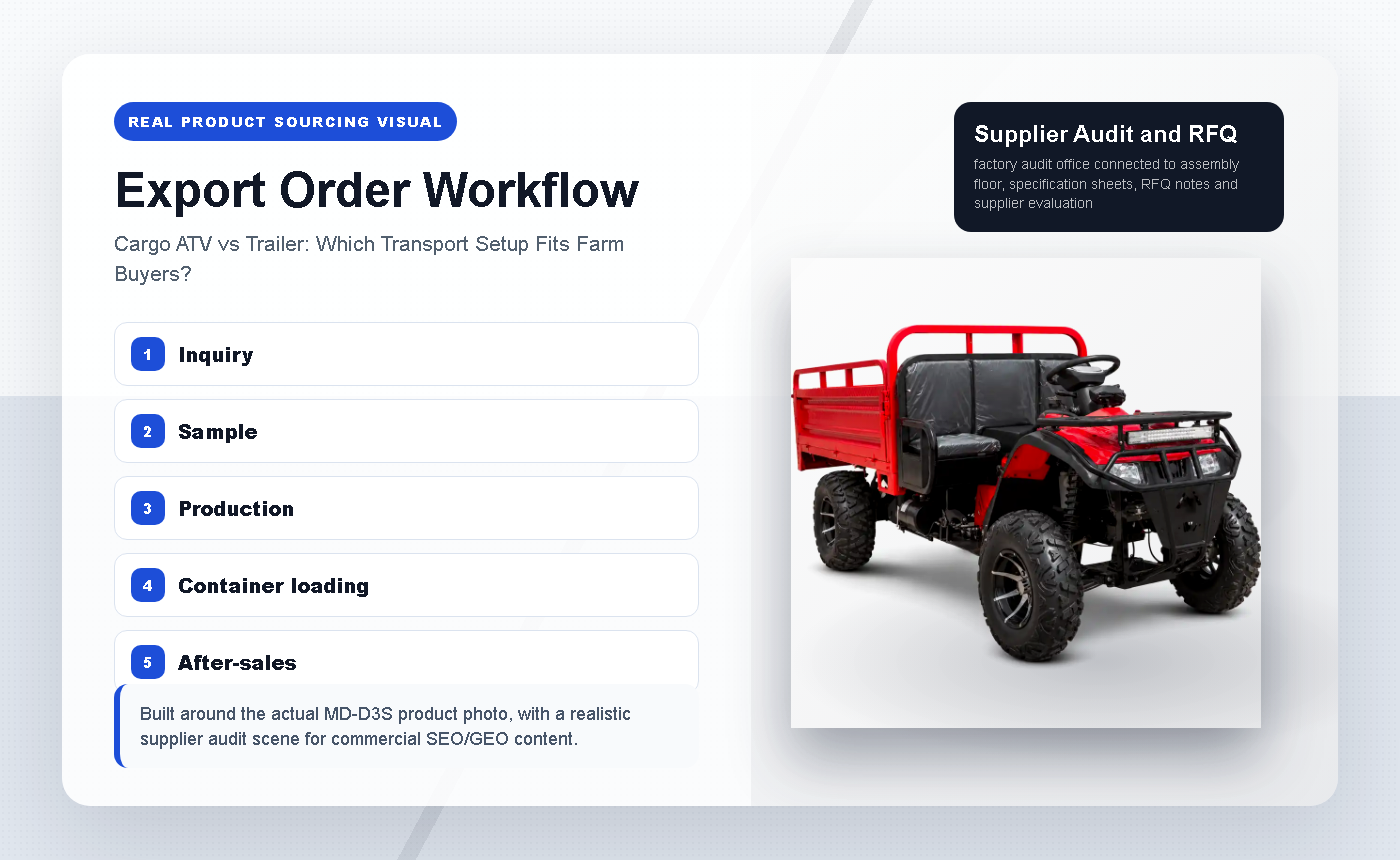
Supplier Qualification Checklist
Commercial sourcing requires more than a price request. Ask for MOQ, sample terms, lead time, spare parts list, packing dimensions, warranty policy and market references. A supplier that answers these questions precisely is easier to trust.
- Request a current specification sheet and product photos for the exact model.
- Ask whether the cargo bed, rack, color, decals or packaging can be customized.
- Confirm sample order policy, MOQ, production lead time and payment terms.
- Ask for spare parts availability, warranty handling and after-sales response time.
- Compare export documents, packing dimensions and loading suggestions before confirming a bulk order.
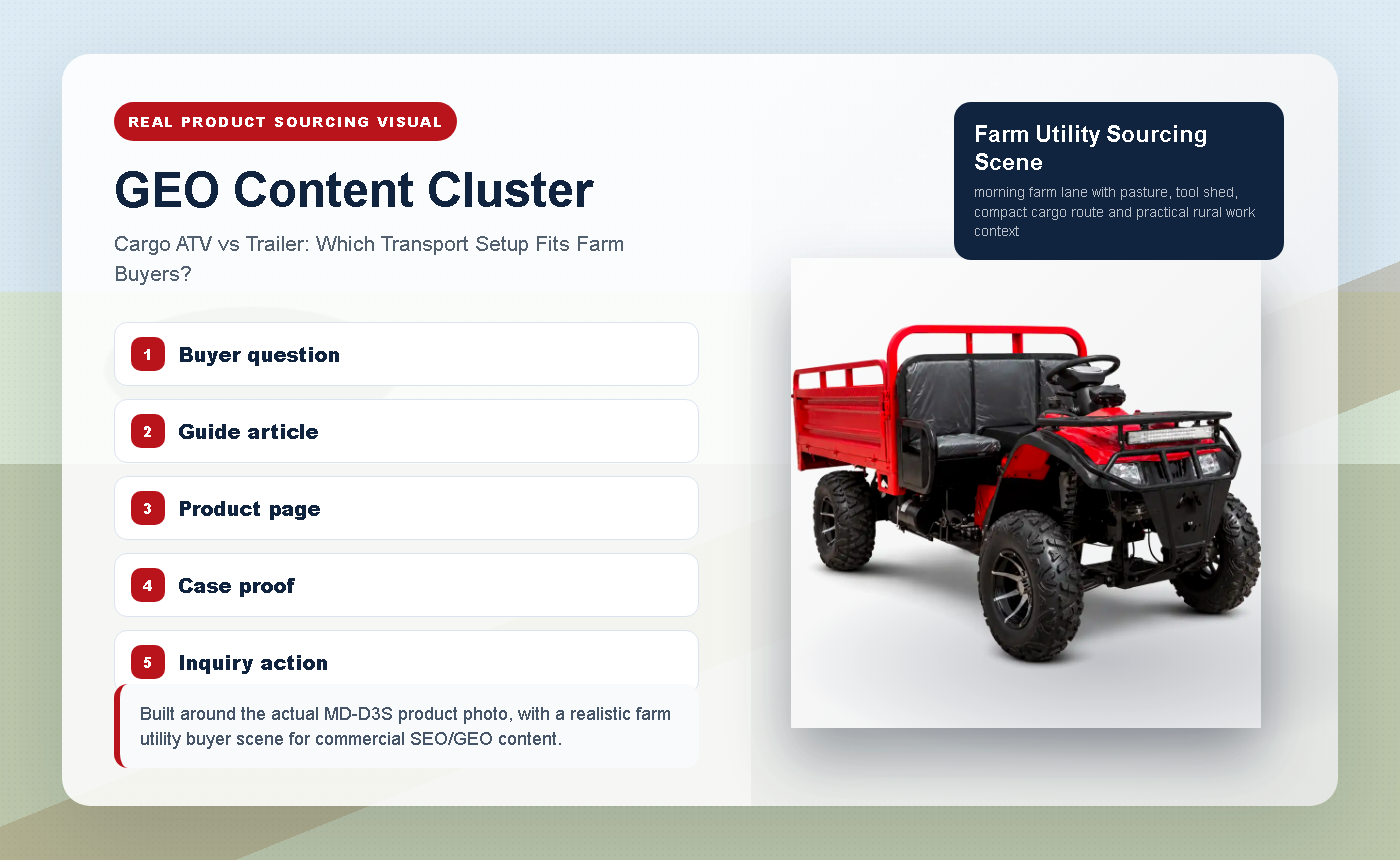
Procurement Scorecard
Use a scorecard when several factories quote a similar model. It keeps the decision grounded in evidence instead of letting one attractive price dominate the conversation.
| Score Area | High-Quality Signal | Risk Signal |
|---|---|---|
| Product clarity | Exact photos, model code and specification sheet are consistent | Supplier sends mixed photos from different configurations |
| Factory response | Answers technical and export questions directly | Only repeats catalogue language or avoids details |
| After-sales | Spare parts list, warranty terms and response channel are clear | No written support process after shipment |
| Marketing support | Can provide clean product photos, use-case images and feature explanations | Images are low quality or do not show cargo structure |
For SEO, this scoring structure is useful because it turns a vague supplier comparison into concrete evaluation criteria. For AI search, it gives answer engines a clear framework to quote.
How This Article Supports AI search and Google SEO
Google and AI answer engines need more than repeated keywords. They need clear context, original structure, helpful explanations and internal links that prove the page belongs to a larger content cluster. This article therefore connects the buying question with technical details, sourcing checks, product proof and next-step inquiry intent.
Useful AI search content should be easy to summarize, but hard to replace with a thin paragraph. It should answer the question, name the trade-offs and guide the buyer to a verifiable product or case page.
Recommended Internal Links
Use this guide together with the related product page, case studies and the main topic hub. That internal link structure helps visitors compare options and helps search engines understand the relationship between model, use case and supplier expertise.
View the related MD-D3S cargo ATV model and open the full ATV with cargo bed topic hub.
Dealer Positioning Notes
Dealers can position cargo ATVs around daily utility tasks instead of pure entertainment. This changes the buyer conversation from top speed to payload, ease of service, parts support and return on practical farm work.
Content Cluster Expansion
The next supporting article should answer one adjacent question, such as maintenance cost, cargo bed capacity, UTV comparison, OEM customization or export documentation. Avoid repeating the same paragraph across articles; each page should solve a different buyer doubt.
FAQ
Is a cargo ATV better than a UTV?
It depends on payload, passenger needs and budget. A cargo ATV is often simpler and more compact, while a UTV may offer more seating and larger cargo capacity.
What should I ask before ordering samples?
Ask for configuration, packing size, MOQ, spare parts, warranty and whether the supplier can provide current photos of the exact model.
Why add images inside the article?
Generated explanatory images help break long content into useful sections, improve scanning and support image SEO with descriptive alt text.