
How to Compare Cargo ATVs and UTVs for Dealer Sourcing
Dive into the cargo ATV vs UTV for dealers comparison: demand patterns, margins, warehousing, QC checks and dealer inventory planning for a balanced catalog.
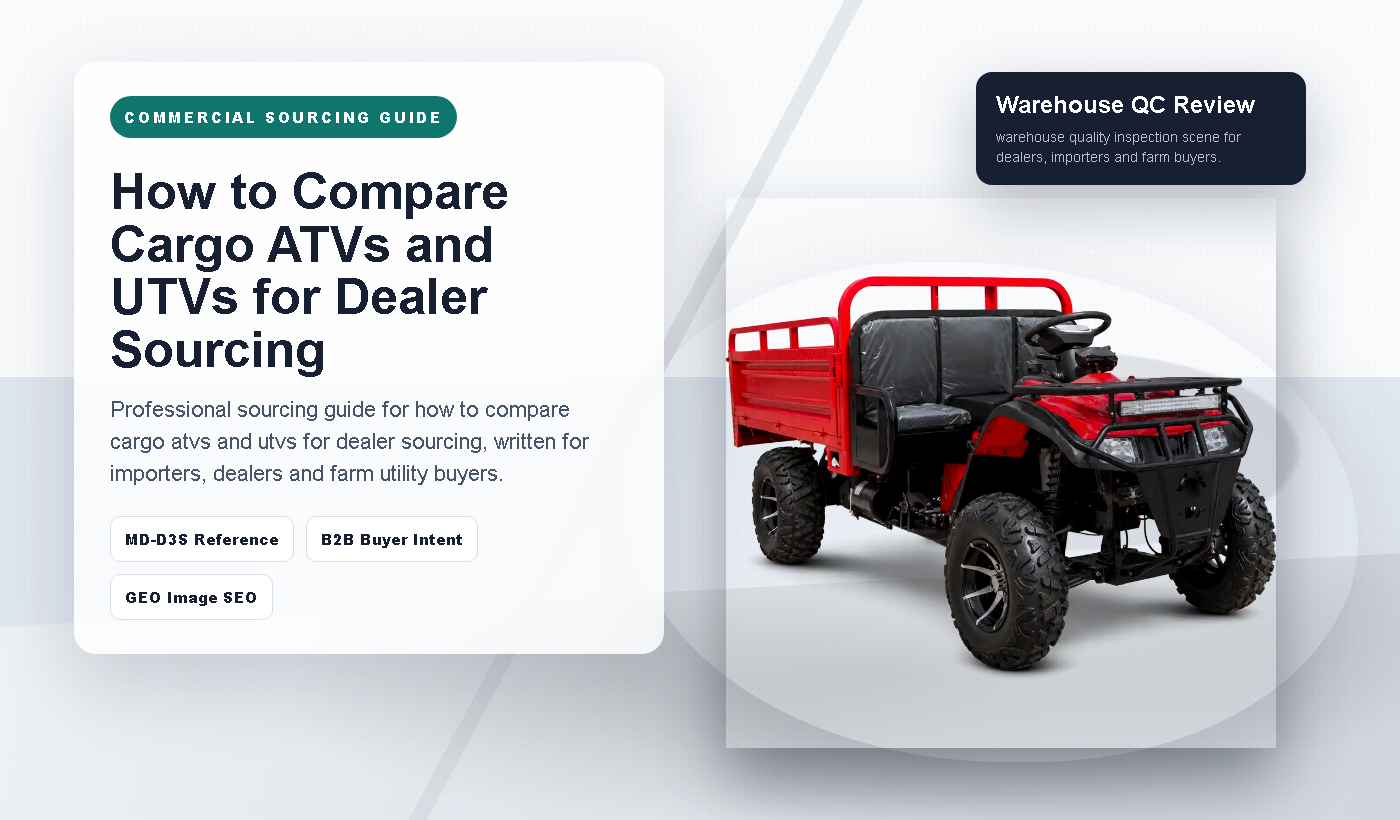
How to Compare Cargo ATVs and UTVs for Dealer Sourcing
When a dealer starts planning a utility-vehicle line, the cargo ATV vs UTV for dealers decision usually comes first. Both machines carry payloads across farms, worksites, and large properties, yet they sell to different buyers, carry different margins, and create very different service obligations. Get the mix wrong and you tie up capital in slow-moving units; get it right and you build a dependable, season-resistant revenue stream. This guide covers customer demand patterns, margin profiles, warehousing, spare parts support, and supplier evaluation criteria, and closes with a sourcing checklist you can hand to your buying team.
Cargo ATV vs UTV for dealers: what the comparison really involves
A cargo ATV is a single-rider machine built around rear racks, towing capacity, and maneuverability. It is light, easy to store, and cheap to run, which makes it the natural fit for small farms, hunting properties, trail maintenance, and landscaping crews that move modest loads over rough ground. A UTV, or side-by-side, seats two or more people, carries a tipping cargo bed, and pulls heavier loads; it behaves like a small work truck and suits larger operations where moving people and materials together is part of the daily routine.
The point for a dealer is that these are complements, not competitors. The buyer who needs a few hundred pounds moved down a fenced lane is not the same buyer who needs a crew of three plus a bed full of feed delivered across two hundred acres. Positioning the two lines against each other on price alone misreads the market. The useful comparison is about who in your territory buys each platform, how fast the units turn, and how much gross profit and service work each sale generates over its life.
Customer demand patterns: who buys each platform
Before you order a single unit, map your local demand. Most dealers find that cargo ATV buyers and UTV buyers cluster into recognizable profiles, and those profiles determine which SKUs deserve floor space.
Cargo ATV buyers and their use cases
The typical cargo ATV customer is a solo operator with a price-sensitive budget. Hobby farmers, smallholders, hunters, grounds crews, and maintenance technicians buy them because they are inexpensive to purchase, insure, and run, and because a single rider rarely needs passenger capacity. The common thread is maneuverability: these buyers work in tight spaces, gateways, and wooded lots where a wider machine is a liability. Sales triggers are usually a worn-out machine, a property purchase, or the start of a season, so demand tends to be steady but spread across the year.
UTV buyers and their use cases
UTV buyers are typically larger operations: working farms, ranches, municipalities, contractors, and property management companies. They need passenger seating, a proper bed, towing capacity, and often cab and climate options, and many treat the UTV as a replacement for a second pickup on light-duty work. Because the ticket is higher, the purchase is more often financed, the decision involves more stakeholders, and the sales cycle runs longer. These customers also return to the dealership for accessories such as windshields, roofs, doors, winches, and bed liners, which makes them more valuable over time than the average cargo ATV sale.
Seasonal and regional demand signals
Demand for both platforms follows the seasons, but the peaks differ. In agricultural regions, expect a spring push as planting and maintenance work begins and a secondary bump before harvest. In hunting and recreation areas, late summer and autumn drive sales of both, with cargo ATVs often leading on volume. In snow-country markets, winter accessory demand such as plows and tracks can extend the selling window for UTVs well past the usual fall peak. Use your own sales history, plus regional trade data where available, to time orders so units land before the local peak rather than after it.
Margin profiles: where the money is made
Cargo ATVs offer lower absolute margins but faster turnover. A typical dealer moves more units per quarter, holds lower floor-plan cost per unit, and earns steady accessory and parts add-ons. UTVs generate significantly more gross profit per unit and attach more accessories, but they sit longer, cost more to floor-plan, and absorb more showroom space. Neither profile is inherently better; the winning approach is a blended margin across the mix, planned against the cash your business can commit to inventory.
Service revenue is where the difference widens. UTVs carry more complexity, including suspensions, bed lift systems, electrical harnesses, and winch installations, so they generate more shop hours and more parts sales over their working life. Cargo ATVs are simpler and more reliable in service, which is good for customer satisfaction but means less recurring revenue. When you compare two potential SKUs, compare lifetime economics, not just invoice price: expected unit turns, accessory attach rate, service hours, and parts consumption over three to five years.
Dealer inventory planning: floor space, freight, and stock turns
Inventory planning for utility vehicles is a balance between breadth, having the right models to meet demand, and depth, not over-committing to configurations that only sell twice a year. The two platforms impose very different physical and financial constraints, so plan them separately.
Warehousing and display footprint
A cargo ATV ships in a compact crate, can be stored tightly, and is even stackable, which makes it friendly to small facilities. A UTV crate is substantially larger and heavier, requires more aisle and display space, and often needs a demo area if you want customers to experience seating, bed operation, and visibility. If your facility is tight, use that constraint as a planning input: carry UTV depth only for proven models and use cargo ATVs for breadth.
Freight, lead times, and cash flow
Typical export lead times run from four to eight weeks for factory production after order confirmation, with ocean freight adding roughly three to six weeks depending on the route and port conditions, so a full sourcing cycle of eight to fourteen weeks from order to delivery is normal. Because UTVs are bulky, a forty-foot container holds far fewer UTVs than ATVs, which raises the landed cost per unit and pushes you toward fewer, more deliberate UTV models. Confirm with your supplier whether mixed containers are possible and how minimum order quantities apply to each platform. Then set stock-turn targets: most dealers aim for multiple turns per year on fast-moving cargo ATVs and accept longer holding periods on higher-margin UTV flagships.
Spare parts support and after-sales obligations
Every unit you sell creates a parts and service obligation, and the two platforms differ sharply in how heavy that obligation is. UTVs need a deeper spare parts commitment because of their complexity; cargo ATVs need fewer SKUs but faster availability on common wear items. Before signing a sourcing agreement, confirm the supplier's parts policy in writing: how long they guarantee parts availability, five to seven years being a reasonable expectation to negotiate, whether they ship wear-item kits with containers, and how warranty claims are processed. Most reputable suppliers accept photo- and video-based claims and ship replacement parts rather than demanding the whole unit be returned; make sure the process is documented before your first order, not after your first problem.
Also request the full service documentation upfront: exploded parts diagrams, torque specifications, wiring schematics, and a maintenance schedule. These documents determine whether your shop can repair units in-house or whether every job becomes a slow, costly exchange with the factory. Dealers that under-invest here discover the true cost of a low parts price: weeks of downtime for customers who will not forget it.
Cargo ATV vs UTV comparison table
The table below summarizes the operational differences that matter most when you are deciding inventory mix. Figures are typical ranges; confirm exact specifications with each supplier.
| Factor | Cargo ATV | UTV (side-by-side) |
|---|---|---|
| Occupancy | Single rider | Two or more passengers |
| Payload style | Rear racks, typically 100-400 lb, model-dependent | Tipping cargo bed, typically 500-1,500 lb, model-dependent |
| Towing capacity | Moderate; suited to small trailers | Higher; suited to equipment and multi-axle trailers |
| Price point | Lower; entry-friendly | Higher; often financed |
| Typical sales cycle | Short, impulse-friendly | Longer; multiple stakeholders |
| Gross profit per unit | Lower | Higher |
| Stock turn | Faster | Slower |
| Floor and storage space | Compact, stackable crates | Large crates, more display space |
| Parts complexity | Lower; fewer SKUs | Higher; deeper parts commitment |
| Service revenue potential | Modest | High |
| Best-fit customer | Solo operators, small properties | Working farms, fleets, contractors |
Supplier evaluation criteria for dealer sourcing ATV and UTV wholesale sourcing
Wholesale sourcing quality determines whether your catalog makes money or makes trouble. Evaluate every candidate supplier against the same structured criteria, in writing, before committing to a container.
Factory certifications and quality control
Start with the factory itself. Ask whether you are dealing with the manufacturer or a trading company, and treat the answer as material: factory-direct sourcing usually means tighter quality control and better pricing, while trading companies can offer convenience and smaller minimums. Request internationally recognized quality-management certification, such as the ISO 9001 series, and any industry-specific compliance credentials the factory holds. Then ask how quality control actually works: incoming parts inspection, welding and frame checks, engine run-in tests, final assembly checks, and whether pre-shipment inspection reports are standard. Offer to pay for an independent third-party inspection on the first order; a factory confident in its process will not object.
Lead times, minimums, and production transparency
Confirm the numbers in writing: current production lead time, minimum order quantities per model, container-mixing options, and what happens when a deadline slips. The best suppliers give you a production schedule you can verify, not just a promised date. Ask how they handle peak-season capacity, because the factory that quotes eight weeks in January may quote sixteen in July. Also clarify payment terms, deposit percentages, and cancellation policies so your cash exposure stays predictable.
Documentation, compliance, and import readiness
A container that clears customs smoothly depends on paperwork prepared months earlier. Require the supplier to provide certificates of origin, detailed commercial invoices, packing lists, and the compliance documentation your destination market demands, including emission and safety certifications where applicable. If you plan to brand units, confirm VIN application, model-year labeling, and whether branding is included in the price. Finally, request two or three export references from dealers in markets similar to yours and check them. Suppliers with a track record of shipping to your region will have fewer surprises in documentation and logistics.
Building a balanced catalog across both platforms
There is no universal ratio, but a sensible starting pattern for most dealers is a small UTV anchor lineup, one entry model, one workhorse, and one premium or cab-equipped model, paired with a broader cargo ATV selection that delivers volume and price points. Let your dealer inventory planning discipline, not supplier enthusiasm, set the depth: track units sold, average days in stock, gross margin per model, and service revenue per sale, and review the mix quarterly. Drop configurations that do not turn, and use pre-orders and deposits to fund flagship UTV stock instead of tying up all your cash upfront. A balanced catalog is one that survives a slow quarter, not simply one that looks comprehensive on paper.
Dealer sourcing checklist
- Map your market: list the ten buyer personas in your territory and note which platform each one needs.
- Set a quarterly budget and floor-plan limit for utility vehicles, split between the two platforms.
- Shortlist three suppliers and request full spec sheets, exploded parts diagrams, and written warranty policies.
- Verify factory credentials: quality certifications, audit history, and export references from similar markets.
- Confirm lead times, minimum order quantities, container-mixing options, and payment terms in writing.
- Review compliance documentation for your destination market before the first order.
- Arrange an independent pre-shipment inspection on your first container.
- Stock a starter spare parts kit for every SKU you carry, not just the best sellers.
- Track turns, margin, and service revenue per model, and review the mix quarterly.
- Time orders so units land before your regional peak selling season, not after it.
Frequently asked questions about cargo ATV vs UTV for dealers
Which platform is more profitable for a dealer: cargo ATVs or UTVs?
It depends on your market and cash position. Cargo ATVs deliver faster stock turns and lower holding costs, which is attractive for smaller dealers; UTVs deliver higher gross profit per unit and stronger service and accessory revenue, which suits dealers with more floor space and working capital. Most successful operations run both and manage a blended margin rather than betting on one platform.
What are typical lead times for UTV wholesale sourcing?
Plan for roughly four to eight weeks of production after order confirmation, plus three to six weeks of ocean freight, for a full cycle of eight to fourteen weeks from order to delivery. Lead times stretch during peak seasons, so confirm the current schedule in writing and order ahead of your selling season.
Can I mix cargo ATVs and UTVs in a single container?
Often, yes; many suppliers will build a mixed container to help you reach your minimum order quantity. The trade-off is that UTVs are bulky, so each mixed container holds fewer total units, which raises the landed cost per unit. Ask for crate dimensions and a loading plan before you commit.
How much spare parts stock should a new dealer carry?
Start with a starter kit per SKU covering wear items such as filters, belts, brake pads, cables, and common seals, plus the service items most likely to fail in your climate. Expand the kit as your installed base grows, and confirm the supplier's parts-availability commitment and claim process in writing before your first order.
What documents should a supplier provide before the first order?
At minimum: full specifications, exploded parts diagrams, warranty terms, quality-control and pre-shipment inspection reports, certificates of origin, commercial invoices, packing lists, and any emission or safety compliance documentation required by your destination market. If any of these are unavailable, treat it as a red flag.
Should I source from a factory or a trading company?
Factory-direct sourcing typically means better pricing, direct quality control, and faster technical support, but often higher minimums and less flexibility. Trading companies can offer smaller orders, mixed sourcing, and easier communication, at the cost of an extra margin layer and less direct oversight. For a first order, many dealers prefer a factory with export experience and a verifiable audit trail.