
Electric ATV Safety Features: What Buyers Should Look For
Electric ATV safety features compared: hydraulic disc brakes, speed limiters, roll cages, IP ratings, export certifications, plus a buyer checklist and FAQ.
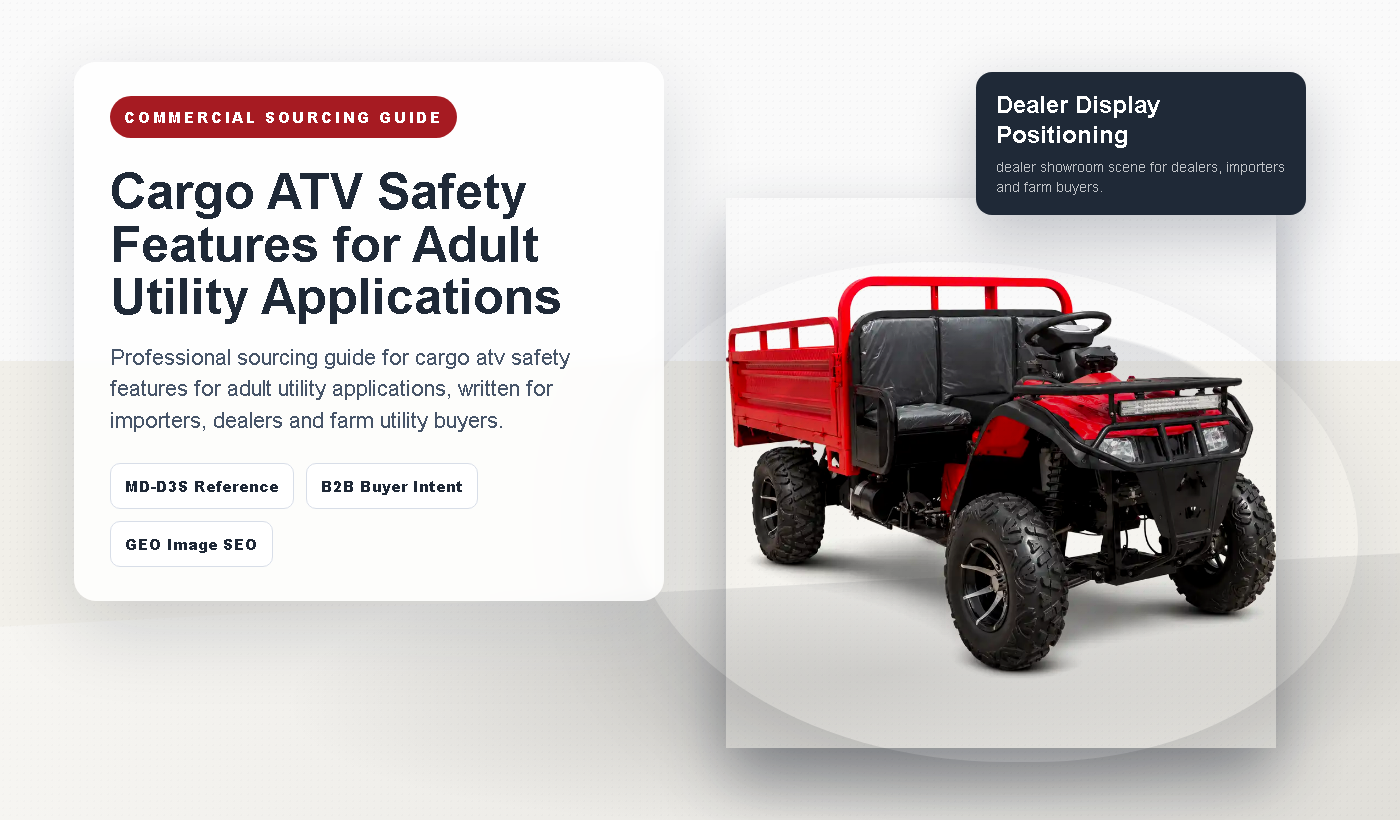
Electric ATV Safety Features: What Buyers Should Look For
Electric ATV safety features determine more than the compliance line on a purchase order. They decide whether the machines you import, distribute, or build for OEM partners will pass dealer inspection, survive field use, and protect the riders they carry. For importers, dealers, and sourcing teams, the most profitable electric ATV line is rarely the one with the biggest battery —it is the one with the strongest, most verifiable safety specification sheet. This guide covers the safety systems you should compare before committing to a supplier, from braking to export certification.
Why Electric ATVs Raise the Safety Bar
Electric powertrains change the risk profile of an ATV in ways buyers often underestimate. An electric motor delivers full torque almost instantly, with no clutch, no gear shift, and no engine note to warn a rider what is coming. A machine that feels gentle at idle can surge the moment the throttle is touched, which is why throttle mapping and speed limiting matter more on electric models than on their gasoline equivalents. Electric ATVs are also quiet: riders, pedestrians, and children on foot often cannot hear one approaching, so lights and reflectors carry a heavier safety load. Finally, the battery pack adds significant low weight that changes center of gravity, handling, and braking behavior. An electric safety review is therefore not the same checklist you would apply to a gasoline model.
There is a commercial reason to treat safety as a specification rather than an afterthought. Safety defects are the fastest route to chargebacks, returns, and damaged distributor relationships. Buyers who can show dealers and end customers a documented safety story —verified brakes, tested speed limiters, certified water resistance —turn that paperwork into a genuine sales advantage.
Braking Systems: The First Line of Defense
Brakes are the single most important ATV safety component, and the gap between a good and a marginal braking system is widest on electric models, which carry the extra weight of a battery. When you evaluate a supplier's brake specification, the first question is simple: hydraulic disc or drum?
Hydraulic Disc Brakes vs. Drum Brakes
Hydraulic disc brakes use a fluid-filled master cylinder to push caliper pistons against a rotor, while drum brakes press curved shoes against the inside of a rotating drum. Both stop a wheel; they do not perform equally. Discs deliver stronger, more progressive stopping power, manage heat better on long descents, and hold their performance in wet, muddy conditions because open rotors shed water and debris. Drums are cheaper and sealed against dirt, but they fade under repeated hard braking, lose effectiveness when wet, and are harder to modulate precisely. On a battery-heavy electric ATV, fade and wet-weather loss are exactly the failure modes you cannot afford.
| Factor | Hydraulic disc brakes | Drum brakes |
|---|---|---|
| Stopping power | Strong, progressive, consistent | Moderate, less predictable under load |
| Heat management | Excellent; rotors dissipate heat quickly | Prone to fade on long or repeated braking |
| Wet and muddy conditions | Strong; open design sheds water | Weak until the shoes dry out |
| Maintenance | Periodic pad and fluid checks | Sealed; occasional adjustment |
| Cost to supplier | Higher | Lower |
| Best suited for | Utility and adult models, hilly terrain | Light youth models, flat low-speed use |
When reviewing a spec sheet, ask for the exact brake configuration: rotor diameter, caliper type, whether both front and rear wheels are braked, and whether the parking brake is mechanical or electronic. Most reputable suppliers can state a stopping-distance figure for their models; if a supplier cannot, treat it as a red flag. Also confirm how regenerative braking interacts with the mechanical system. Motor braking extends pad life and adds a safety margin on descents, but it is not a substitute —the mechanical brakes must stop the fully loaded machine on their own, because a depleted battery or a controller fault can remove regen assistance without warning.
Speed Limiters and Throttle Response
For the youth segment, speed limiting is the difference between a family product and a hazard, and it is the first thing parents, retailers, and regulators ask about. A proper limiter system offers several layers, and a B2B buyer should verify each one rather than accept a single top-speed number.
- Top-speed limiter: a cap on maximum speed, ideally switchable, such as a low learner mode and a higher standard mode.
- Throttle ramp: the rate at which power builds when the throttle is pressed. A soft ramp prevents the instant-torque lurch of an electric motor and matters more than the speed cap for young riders.
- Keyed or coded mode switching: a physical key or code that stops a child from silently switching to the high-power mode.
- Remote or tether kill switch: a parent-held remote that cuts power instantly; strongly recommended on youth models.
As a rule of thumb, most suppliers of youth electric ATVs offer learner speeds in the 5-10 mph range and standard modes in the 10-15 mph range, with adult and utility models substantially higher. Those figures are a useful negotiating baseline, but the engineering behind them matters more: is the limiter implemented in software only, or is there a physical element? Can it be bypassed with a simple procedure? Ask for the tamper-resistance rationale and test the mode switching on a sample unit. Speed limiting is a core element of kid ATV safety, so if you serve the youth market, document it thoroughly in your product listings and manuals.
Lighting and Reflectors: Visibility on Both Ends
Electric ATVs are quiet, which makes them harder to see and hear —so the lighting package is a safety system in its own right. A complete ATV lights package includes a bright headlight, a tail light, a brake light that activates with the brake lever, and reflectors positioned front, rear, and side. LED lights are now standard from most suppliers and worth insisting on: they are brighter, draw less from the battery, and last far longer than incandescent bulbs.
Compare suppliers on more than "LED included." Ask for lumen output, beam pattern, and a high/low setting —a wide, even beam is safer than a bright, narrow one. Check that the brake light is clearly visible in daylight and that reflectors meet the reflectivity standards common in your target market. For utility use, confirm the machine can run with lights on continuously without draining the battery unacceptably. And remember visibility works in both directions: lights help the rider see the trail, while reflectors and the brake light help other people see the rider.
Roll Cages and Frame Protection for Utility Models
The ATV roll cage conversation differs for electric models because the market splits: compact youth machines carry no cage, while utility and adult models increasingly do. If you source utility electric ATVs —machines for farm work, property maintenance, or off-road touring —the roll cage is a primary safety component, and its quality is easy to verify once you know what to look for.
A genuine cage is a welded structure of steel or heavy aluminum tube, engineered to protect the occupant in a tip-over, with solid frame mounting points, padding on the bars a rider can contact, and integration with a seat belt. A cosmetic cage that bolts loosely to the body, with thin walls and weak welds, provides no protection and creates a false sense of security. Ask the supplier for tube material and wall thickness, the weld standard, the number of mounting points, and whether the cage has been tip-over tested. On utility models, also examine the main frame —gusseted joints and adequate tube thickness —and the battery enclosure. An exposed battery box is a safety and warranty liability no matter how good the cage looks.
Seat Belts, Hand Guards, and Body Protection
Beyond the headline systems, the details separate a professional build from a budget one. On any model with a roll cage, a seat belt is non-negotiable —a lap or three-point belt the rider can operate one-handed. On youth models without cages, belts are generally not fitted, so the speed limiter and throttle ramp carry the safety load instead.
Hand guards are a small component with a large effect: they shield hands from branches and debris at speed, protect knuckles in low-speed tip-overs, and keep mud and water off the brake levers. They are inexpensive, and most suppliers will fit them on request —but they belong on the specification sheet, not left to chance.
Other details worth specifying: chain and gear guards that keep clothing and debris away from moving parts, foot guards with adequate grip, fenders that cover the tires fully, and adjustable seats and handlebars. The last point matters more than most buyers realize —a rider who cannot reach the controls comfortably is a risk no component can fix, so adjustable ergonomics are a legitimate ATV safety feature for growing riders and multi-user fleets.
Water Resistance and IP Ratings
Electric ATVs work outdoors, often in weather that would end a lesser machine, so water resistance is both a durability spec and a safety spec: water ingress into a battery or controller is a fire and shock hazard, not just a reliability nuisance. The industry shorthand is the IP rating. The first digit covers solids —5 means dust-protected, 6 means dust-tight. The second digit covers liquids —4 splashing, 5 jets, 6 powerful jets, 7 temporary immersion.
Ask for the IP rating of each critical component, not one number for the whole machine. A typical good build carries a higher rating on the battery enclosure, a slightly lower rating on the controller and display, and waterproof connectors throughout. Do not accept a vague "waterproof" claim with no rating behind it. Ask how the rating was verified —most suppliers test to the relevant IP standard and can share the method —and confirm the charging connector is protected, because the charging port is the most common point of ingress in real use. If you source for wet-climate markets, make the minimum IP ratings for battery, controller, and connectors a contractual term, not a talking point.
Certification and Compliance for Export Markets
Safety features must be documented, and that documentation is what lets you import, insure, and sell. Requirements vary by destination market and machine class, and they change, so treat this as a framework rather than legal advice. In the European Union, electric ride-on and utility vehicles generally need CE marking and compliance with the applicable directives, RoHS, and battery transport rules. Lithium batteries shipped internationally must meet the UN 38.3 transport test regime, and many markets now apply stricter rules to battery imports. Youth machines in many markets are judged against age-graded standards —which is where kid ATV safety requirements intersect with certification.
Build a verification workflow: require the declaration of conformity or equivalent documentation, the relevant test reports, and the battery transport documentation before you issue a purchase order. Verify the documents with the issuing body or a qualified local partner —a photocopy from an unknown lab is worthless in a customs audit. Confirm what markings must appear on the product label and in the manual, and negotiate a warranty and recall clause that covers safety defects. Most suppliers can provide these documents on request; the ones that cannot are the ones to walk away from.
Electric ATV Safety Features: The Buyer's Spec Checklist
Use this checklist as the core of your request for quote and your pre-shipment inspection. Hand it to your supplier and mark each line verified.
- Braking: hydraulic disc front and rear, rotor size stated, parking brake confirmed, stopping-distance figure on request.
- Throttle: verified throttle ramp, switchable speed modes, keyed or coded locking, remote kill switch option.
- Lighting: LED headlight with stated lumen output, tail light, brake light, front/rear/side reflectors, daytime running light capability.
- Structure: roll cage material, wall thickness, weld standard, mounting points, and seat belt integration on utility models.
- Protection: hand guards, chain and gear guards, fender coverage, adjustable ergonomics for the rider range.
- Water resistance: stated IP rating per component —battery, controller, motor, connectors, charging port —with test method.
- Certification: declaration of conformity, test reports, battery transport documents, label markings, safety recall clause.
- Documentation: operator manual in your market's language, warning labels, and a service manual for your dealer network.
FAQ: Electric ATV Safety Questions Buyers Ask
Are hydraulic disc brakes worth the extra cost on electric ATVs?
For adult, utility, and hilly-terrain models, yes —stronger stopping power, heat resistance, and wet-weather performance directly offset the higher cost, and braking is the feature dealers probe first. For very light youth machines on flat ground, a quality drum brake can be acceptable, but many suppliers now fit discs across the range, which simplifies your inventory and your safety story.
What top speed should a kids' electric ATV be limited to?
There is no universal figure, but most suppliers of youth electric ATVs offer a learner mode in the 5-10 mph range and a standard mode around 10-15 mph, with age-graded recommendations in the product documentation. What matters for kid ATV safety is that the limiter cannot be easily bypassed and that the throttle ramp prevents sudden power surges.
Do all electric ATVs come with a roll cage?
No. Compact youth models generally do not carry roll cages, while many utility and adult models do. If a machine has a cage, verify it is a properly welded, securely mounted structure with a compatible seat belt —not a decorative bolt-on. If a machine has no cage, its speed limiting and throttle tuning carry the safety load instead.
What IP rating should I look for in an electric ATV?
Demand a rating per component rather than a single machine-wide number. A common good build is dust-tight on the battery enclosure with liquid protection suitable for jetting or splashing, waterproof connectors, and a protected charging port. Ask how the rating was tested and put the minimum ratings in your contract, especially for wet-climate markets.
What certifications do I need to import electric ATVs into my market?
Requirements vary by destination and machine class and change over time. Common elements include CE marking and RoHS compliance for EU markets, UN 38.3 transport documentation for lithium batteries, and age-graded standards for youth machines. Confirm current requirements with the relevant authority or a qualified local partner before issuing a purchase order.
How can I verify a supplier's safety claims before ordering?
Ask for the test reports behind every claim —brake tests, IP ratings, limiter behavior, roll cage testing —and inspect a sample unit personally. Combine the paperwork with a pre-shipment inspection against the checklist above, and negotiate a warranty and recall clause covering safety defects.