
What to Ask an Electric Vehicle Factory Before Bulk Orders
Essential electric vehicle factory questions every B2B buyer must ask before bulk orders: certifications, battery cells, QC, lead times, warranty, and parts.
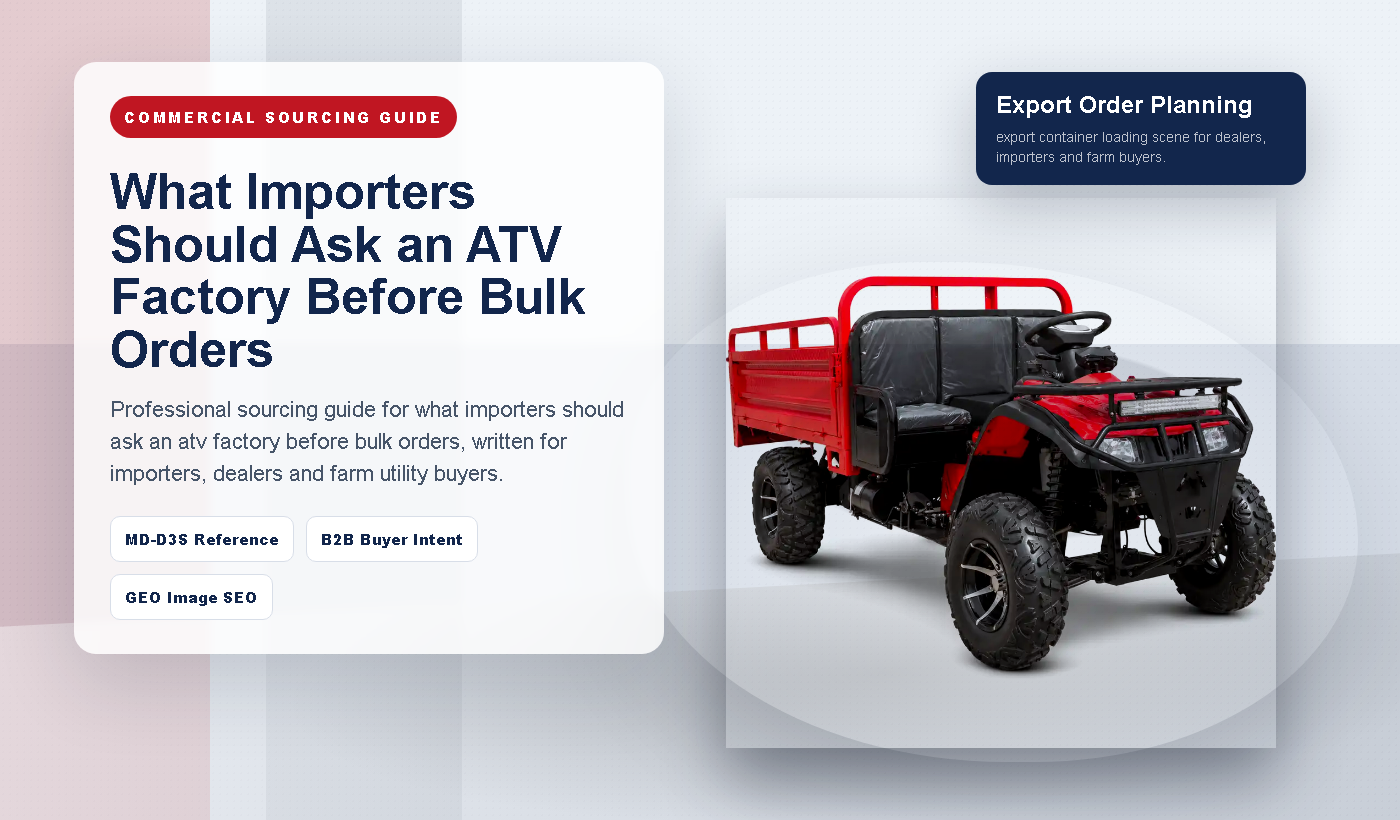
What to Ask an Electric Vehicle Factory Before Bulk Orders
Ordering a single electric vehicle for personal use is easy. Ordering a container of them — or committing to a year-long supply agreement — is a completely different game. When your business name, your margins, and your customer relationships ride on one production run, the electric vehicle factory questions you ask before you sign matter more than the unit price on the quotation. Most importers who end up with delayed shipments, mismatched specifications, or batteries that fail within months could have caught the problem during sourcing — if they had asked the right questions.
This guide gives B2B buyers a complete checklist of what to ask an electric vehicle factory before bulk orders: certifications, battery cells, quality control, production capacity, lead times, payment terms, warranty coverage, spare parts, and verifiable reference customers. Use it during factory audits, video walkthroughs, and contract negotiations to separate serious manufacturers from order-taking middlemen.
Why Supplier Due Diligence Decides Your Margins
One bad batch does not cost you only the price of the goods. It costs you freight, customs clearance, storage, rework labor, customer refunds, and — most expensive of all — the trust of the dealers who bought from you. In our experience with importers of ATVs, UTVs, go karts, electric motorcycles, and utility vehicles, buyers who negotiate hardest on price are often the ones who pay most in the end. The lowest quotation usually comes from a factory that either quotes a specification it cannot deliver or plans to cut corners on components you cannot see — battery cells, controllers, wiring harnesses, welds.
Meanwhile, the supplier that answers technical questions in writing, shares test data without hesitation, and welcomes inspection is almost always the one that delivers on time. A price list tells you what a factory wants you to pay; a detailed Q&A tells you what the factory can actually deliver.
The Complete Electric Vehicle Factory Questions Checklist
The full manufacturer checklist below is organized by category. Send the questions in writing before the meeting, then use the call to probe the answers and watch how the supplier reacts. Hesitation, vagueness, and sales-speak are answers in themselves.
1. Certifications and Regulatory Compliance
Certifications are the first filter. If a factory cannot produce the right documents for your target market, nothing else on this list matters — the shipment will sit at customs or be rejected at the border.
- Which certifications does this exact model carry for the European Union (CE marking), North America (UL), and your other target markets?
- Can you send copies of the certificates with the model number, report number, and issuing body clearly visible?
- Do the certificates cover the exact configuration I am buying, or a similar model?
- Is the lithium battery pack certified for transport (UN38.3), and does the packaging meet dangerous-goods shipping requirements?
- Does the vehicle comply with RoHS and REACH restrictions on hazardous substances?
- Who issues and renews the certificates, and how often are units re-tested?
Request the actual certificate documents, not a photo of a plaque on the wall. Check that the model number on the certificate matches the model number on your quotation — certificates are issued for specific configurations, and a certificate for a 60-volt scooter does not cover the 72-volt version with a different battery. Customs and market surveillance authorities in the EU and North America increasingly check compliance documents at the point of import.
2. Battery Cell Brand and Chemistry
The battery is the most expensive component in an electric vehicle and the most likely to fail. How a factory answers battery questions tells you more than any other part of this checklist.
- Which cell brand do you use, and can you confirm whether the cells are A-grade or B-grade?
- What is the cell chemistry — lithium iron phosphate (LFP), NMC, or lead-acid?
- What is the rated cycle life, capacity, and continuous discharge rate of the pack you are quoting?
- Who supplies the battery management system (BMS), and what protections does it include?
- How are battery packs tested before assembly and before shipping?
- What is your policy if a batch of cells from your supplier is recalled or fails incoming inspection?
Experienced EV factory suppliers name their cell brand openly and provide datasheets. A factory that answers "we use a well-known brand" without naming it is usually using cells it does not want you to investigate. Cell grade matters as much as brand: B-grade cells are cheaper but deliver noticeably shorter cycle life and more variance between units — a difference your end customers will feel within the first year.
3. Quality Control Process
Quality control separates a genuine manufacturer from an assembler. Ask about the process, not the claim.
- Do you perform incoming inspection on components such as cells, motors, and controllers, or do you trust your suppliers?
- What in-process checks happen during assembly, and what is tested on every finished unit versus a sample?
- What sampling standard do you use for final inspection — for example, which AQL levels?
- Which parameters are recorded per unit: voltage, charging behavior, motor output, braking distance?
- Do you allow third-party pre-shipment inspection, and who pays for it?
- What was your documented defect rate on recent export orders, and what happens to units that fail inspection?
Most reputable factories welcome third-party inspection because it protects their reputation as much as your money. If a supplier resists independent inspection or restricts what the inspector can see, treat that as a major red flag.
4. Production Capacity and Scheduling
- What is your monthly production capacity for this model?
- How much of that capacity is currently committed to other orders?
- What is your minimum order quantity (MOQ) for this model, and for a mixed container?
- Can you scale production if our volumes grow, and how much notice do you need?
- How many production lines do you run, and what is your current staffing level?
- If capacity is full, what is your honest lead time rather than your ideal one?
Ask for capacity figures in writing and cross-check them against your order size. A small factory can be an excellent partner if its capacity matches your volume; the danger is a supplier that accepts orders it cannot physically produce, then pushes your delivery back to fit others in front of you.
5. Lead Times and Shipping
- What is the production lead time for my order size and configuration?
- What are typical export lead times from your port to my destination port?
- What does the quoted lead time include — production, testing, loading, and documentation?
- Which incoterms do you quote, and what exactly is included in the price: packaging, pallets, loading, export customs clearance?
- How do you communicate schedule changes, and how much buffer should I plan?
- Do you keep popular models and common spare parts in stock?
As a generic benchmark, most suppliers quote 15–45 days of production plus 20–40 days of ocean freight for typical routes, but confirm every quote in writing per order. Add your own buffer for customs clearance and port congestion, especially during peak shipping seasons.
6. Payment Terms and Pricing Transparency
- What are your standard payment terms — for example, T/T with a 30% deposit and 70% before shipment, or a letter of credit?
- What exactly does the quoted price include: certification costs, packaging, pallets, loading, documentation?
- In which currency is the quote valid, and for how long?
- What could change the price after signing: raw material costs, exchange rates, specification changes?
- Do you offer volume discounts, and at what quantities do they apply?
- Is a sample order priced separately, and is the sample cost deducted from the bulk order?
The most common arrangement in the industry is a 30% deposit with the balance before shipment, with letters of credit for larger or repeated orders. Be wary of suppliers that demand a large upfront percentage or are vague about what moves the price. A written price breakdown — vehicle, battery, packaging, freight, documentation — makes later disputes much easier to resolve.
7. Warranty Policy and After-Sales Support
- How long is the warranty on the vehicle, and separately on the battery?
- What exactly is covered: motor, controller, battery, frame, or only specific parts?
- How are warranty claims filed, and what evidence do you require?
- Do you ship replacement parts first, and who pays shipping in each direction?
- Do you provide wiring diagrams, maintenance manuals, and diagnostic documentation?
- Do you offer remote technical support or training for our service team?
A common industry pattern is a one-year warranty on the vehicle with a battery period that depends on chemistry and brand — but never rely on what is "typical." Get the warranty terms into the contract, in writing, before you pay the deposit, and keep the exact policy document the factory issues.
8. After-Sales Parts Availability
- Which spare parts do you stock for this model, and what is the lead time for each category?
- Is there a minimum order value for spare parts?
- Do you provide a spare parts catalog with part numbers?
- Will parts remain available for this model after production ends?
- Are parts interchangeable across your model range?
Dealers live and die by parts availability. A vehicle that cannot be repaired is a liability, not an asset. Ask the factory to recommend a first-order spare parts package — a common practice is to budget 5–10% of order value for high-wear parts such as brake components, controllers, chargers, and cables.
9. Reference Customers and Verifiable Track Record
- Can you provide contactable customers in my region or in similar markets?
- Which countries have you exported to in the past 12 months?
- Can you share example export documents with confidential data removed?
- What is the largest single order you have fulfilled, and when?
- How long have you been manufacturing electric vehicles specifically, rather than other products?
- Can we arrange a live video walkthrough of the production line and speak directly with your quality manager?
Talk to at least one existing customer — ideally one importing into the same market you serve. Ask about delivery punctuality, defect rates, and how warranty claims were handled. Twenty minutes with a real reference is worth more than any brochure or trade show booth.
How to Verify the Answers: A Practical Factory Audit Questions Shortlist
Answers are only as good as the verification behind them. Before you commit to a bulk order EV, confirm the claims with these steps — a condensed factory audit questions list for on-site or remote checks:
- Send the checklist in writing first, then compare the answers you get by email, on a call, and in person. Consistency across channels is a good sign.
- Request a live video walkthrough showing the production line, warehouse, finished units, and the specific model you are buying — with a visible timestamp.
- Order a sample and test it yourself for two to four weeks. Open the battery pack (with permission) to confirm the cell brand, and verify certificate numbers online where possible.
- Use a recognized independent third-party inspection agency, such as SGS or Bureau Veritas, for your first bulk shipment, and have the report sent directly to you.
- Start with a trial order — a smaller or mixed container — before signing a long-term supply agreement.
What a Strong Supplier Should Show You: EV Supplier Questions Comparison Table
The table below summarizes how a reliable factory and a risky supplier typically respond to the same requests.
| What you request | A reliable factory provides | A risky supplier does |
|---|---|---|
| Certification documents | Copies with matching model numbers, report numbers, and valid issuing bodies | Photos of plaques, certificates for other models, or vague promises |
| Battery cell details | Brand, grade, chemistry, and datasheet named openly | Says "a well-known brand" without naming it |
| Quality data | Recorded test parameters and defect rates per shipment | Claims of "high quality" with no supporting data |
| Third-party inspection | Welcomed and supported | Resisted, restricted, or heavily delayed |
| Payment terms | Standard industry terms with a written price breakdown | Large upfront payments or vague pricing |
| Warranty and parts | Written warranty terms and a published spare parts list | Verbal promises and "we will handle it later" |
| Customer references | Contactable customers in your market | References that are unreachable or unnamed |
Negotiating with the Answers You Collected
Every answer you collect is negotiation material. Put the commitments in writing: lead times, capacity reservations, warranty terms, spare parts pricing, and penalty clauses for late delivery. A factory that commits in writing plans to deliver; one that refuses is telling you everything you need to know.
Use milestone payments tied to verifiable events: a deposit on contract signing, a second payment after production photos and inspection results, and the balance after the goods pass pre-shipment inspection and are loaded. This structure is standard in the industry and protects both sides — you are not funding production with no visibility, and the factory is not shipping goods with no commitment.
Electric Vehicle Factory Questions: FAQ
What certifications should an electric vehicle factory have before a bulk order?
At a minimum, ask for CE marking for the European market, UL certification for North America, RoHS compliance for restricted substances, and UN38.3 certification for lithium battery transport. The certificates must match your exact model number and configuration.
How many sample units should I order before committing to a bulk order EV?
Order at least one fully configured sample of the exact specification you intend to buy — two or three if you are comparing options. Test it in real conditions for two to four weeks — charging, range, hill performance, component quality — and confirm the battery cell brand before you scale up.
What is a typical minimum order quantity for electric vehicles?
Minimum order quantities vary by model and supplier. As a generic guide, established factories often ask for 10–50 units per model, and some allow mixed-model containers at a slightly higher per-unit cost. Confirm the MOQ in writing — it directly affects your cash flow and warehouse planning.
How long does a bulk electric vehicle order take from deposit to delivery?
Typical export lead times are 15–45 days of production plus 20–40 days of ocean freight for most routes, depending on the destination and the shipping season. Confirm the timeline in writing and add your own buffer before promising delivery dates to your customers.
What payment terms do most electric vehicle factories offer?
The most common arrangement is a 30% deposit with the balance paid before shipment, usually by T/T, with letters of credit used for larger or repeated orders. Avoid paying the full amount upfront, and always ask for a written price breakdown so you know exactly what the deposit and balance cover.
Should I visit the factory, or can I audit it remotely?
A physical audit is ideal, but a live video walkthrough combined with a recognized third-party inspection agency is a reasonable alternative for a first order. Whatever you choose, verify the certificates, talk to a reference customer, and test a sample unit before committing to a bulk order.