
Farm ATV vs Trailer: Which Transport Setup Fits Your Farm?
Farm ATV vs trailer: compare hauling capacity, cost, maneuverability, maintenance, and terrain access to pick the right farm transport setup for your operation.
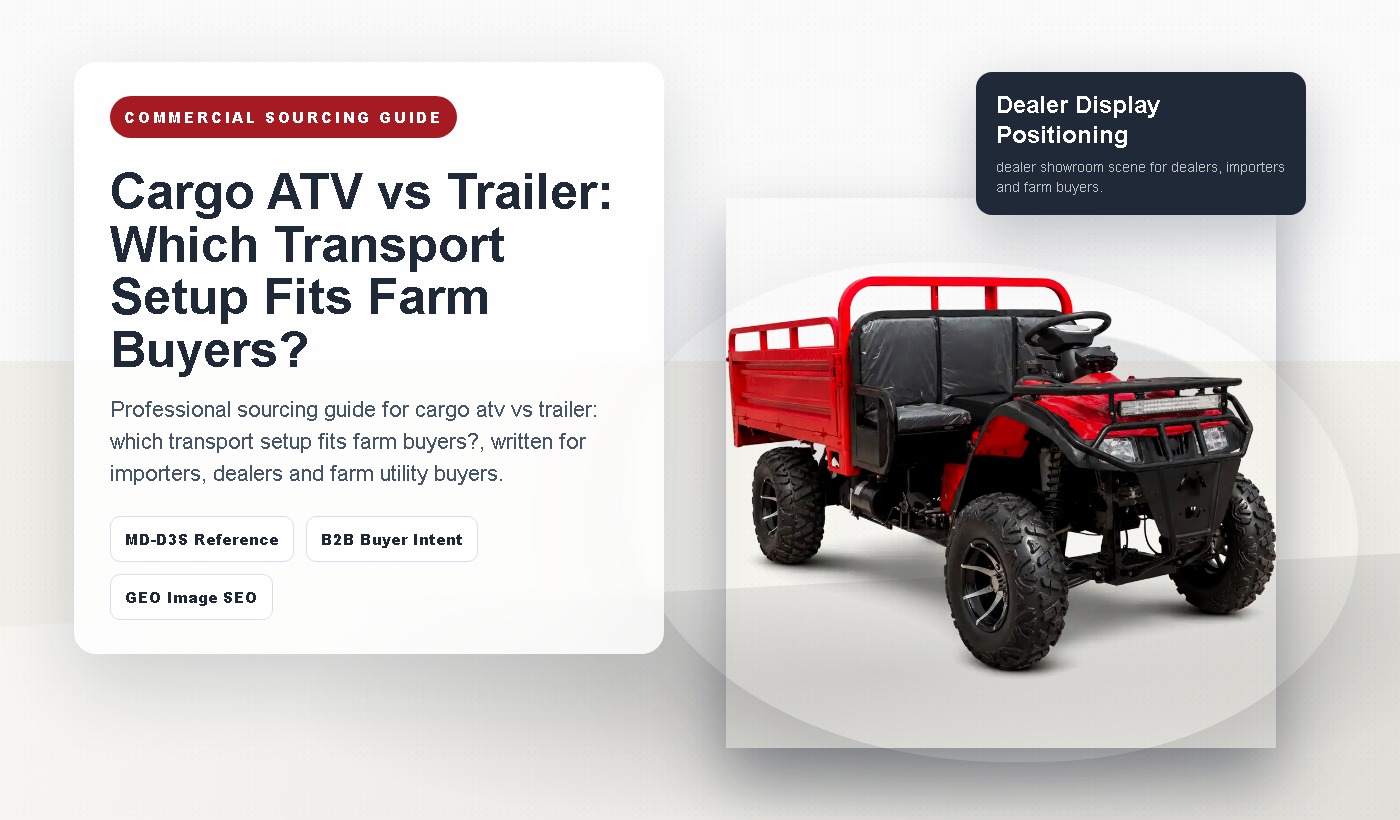
Farm ATV vs Trailer: Which Transport Setup Fits Your Farm?
Every working farm moves material, and the farm ATV vs trailer decision sits near the top of most equipment purchasing lists. Importers, dealers, and OEM sourcing teams frequently ask us which configuration to stock, and the honest answer is that it depends on payload, terrain, and daily workload. This guide compares ATV cargo beds, ATV towing trailer setups, and larger farm machinery so you can choose a farm transport setup that fits the job and the budget. We focus on practical, generic industry figures rather than marketing claims.
Why the Farm Transport Setup Decision Matters
Farms move feed, seed, fertilizer, tools, fencing, water, and harvested product almost every working day. The equipment chosen for those trips shapes labor hours, fuel use, soil compaction, and maintenance cost over the full life of the machine. A farm transport setup that is too small means extra passes and wasted time; one that is too large means a higher purchase price, heavier fuel bills, and a bigger storage footprint.
The decision also matters at the buying level. Dealers deciding which configurations to stock need to know whether demand leans toward bare ATVs, ATV towing trailer combinations, or larger machines. OEM sourcing teams need to specify hitch ratings, tire load indexes, and suspension that match real loads. Getting these details right before production avoids warranty claims and unhappy end users later.
Farm ATV vs Trailer: Capacity and Cost Compared
The heart of the farm ATV vs trailer question is what each setup can physically move. The figures below are typical ranges across most suppliers; always confirm them against the specification sheet of the exact machine you are evaluating.
Typical Payload and Towing Capacity
A standard utility ATV with a rear cargo bed typically carries 100–200 kg (220–440 lb) on the bed, depending on rack design, tire rating, and suspension. Add a trailer and the same machine can tow roughly 350–600 kg (770–1,320 lb), with some models rated higher when fitted with a reinforced hitch and low-range gearing. A compact utility vehicle with a dump bed moves 350–600 kg without any trailer, and a small farm tractor with a loader or towed wagon handles 1,000 kg and up.
Brochure numbers rarely tell the whole story. Braking, hitch construction, tire load index, and slope all change what is safe to carry. Most manufacturers recommend derating towed loads by 20–30 percent on soft ground and gradients, and total weight must always include the trailer itself.
| Transport Setup | Typical Payload | Typical Towing Capacity | Best For |
|---|---|---|---|
| ATV with cargo bed only | 100–200 kg (220–440 lb) | None (bed only) | Quick trips, tools, small feed bags |
| ATV with trailer (ATV towing trailer) | 100–200 kg bed plus 350–600 kg trailer | 350–600 kg (770–1,320 lb) | Bulk feed, seed, fencing, water |
| UTV with dump bed | 350–600 kg (770–1,320 lb) | Up to 1,000 kg with reinforced hitch | Mixed utility work and higher volume |
| Small tractor with wagon or loader | 1,000 kg and up | 1,500 kg and up | Harvest, manure, bulk commodities |
The Real Cost Difference
Purchase price is only the first line. The full cost of any farm hauling option includes fuel, tires, bearings, hitches, brakes, insurance, and storage. Exact prices vary widely by market, specification, and supplier, so the comparison below uses relative cost tiers rather than list prices.
| Cost Factor | ATV with Cargo Bed | ATV with Trailer | UTV or Small Tractor |
|---|---|---|---|
| Typical purchase cost | Lowest | Low to mid | Highest |
| Trailer or attachment cost | Not required | Moderate; varies with size and build | Variable; wagons are costly |
| Fuel per hour | Lowest | Low; rises slightly when loaded | Highest |
| Maintenance complexity | Low | Moderate; tires, bearings, hitch wear | High; hydraulics, PTO, driveline |
| Storage footprint | Smallest | Moderate; trailer adds length | Largest |
Notice where the money actually goes. The trailer adds a second set of tires, wheel bearings, and a hitch that all wear and need service. A UTV or tractor adds hydraulics, driveline components, and often more complex electronics. For many farms the ATV with a trailer hits the sweet spot: a modest purchase price, moderate running cost, and enough capacity for the loads that come up most weeks.
Maneuverability and Terrain Access
Tight Spaces and Gateways
An ATV without a trailer turns inside its own footprint and can reverse through a standard gateway in one or two moves. Add a trailer and you gain capacity but give up maneuverability: the effective turning radius lengthens, backing into a shed becomes a repeated-adjustment job, and gates need to be wide enough for the trailer track, not just the machine.
On farms where storage, feeding areas, and work sites are separated by narrow passages, that difference shows up several times a day. Measure gateways and doorways before choosing a trailer width, and remember that an empty trailer is easier to park than a loaded one.
Mud, Slopes, and Soft Ground
Terrain is where the farm ATV vs trailer tradeoff becomes physical. A loaded trailer transfers weight onto the tow ball, which changes how the ATV's rear tires bite. On wet pasture or soft ground, a heavy trailer can push the machine wide on corners and sink into ruts. A cargo bed keeps weight directly over the rear axle, improving traction but limiting volume.
On slopes, a loaded trailer raises the center of gravity of the combination and increases rollover risk, especially when turning downhill. Most operators keep trailer loads light on gradients, use low range, and never carry passengers on the trailer. If your operation is mostly hilly or boggy, an unloaded machine with a modest bed load is often the safer farm transport setup than a maxed-out trailer.
Trailer vs Cargo Bed on the Same Machine
The trailer vs cargo bed choice is rarely permanent. Many farms run the same ATV with a cargo bed for quick jobs and hitch a trailer only for bulk loads. That flexibility is a genuine advantage of the ATV platform: the base machine stays small, simple, and cheap to run, while capacity appears when needed.
When specifying machines, look for a cargo bed long enough for fence posts and ladders, and a hitch point rated for the trailer you plan to sell alongside it. Matching the trailer rating to the machine rating at the point of sale prevents users from overloading either component.
Maintenance and Downtime Realities
An ATV is one of the simplest machines on a farm: an engine, a drivetrain, four wheels, and a bed. Routine maintenance is oil, filters, chain or belt adjustment, and tire pressure. A trailer adds a second set of tires, wheel bearings that need periodic repacking, a hitch coupler that needs lubrication, and, on road-going units, lights and brakes that need checking.
UTVs and tractors bring more moving parts — hydraulics, dump mechanisms, PTO shafts, and heavier brakes — which means more scheduled service and a higher chance that a failure takes the machine out of service at a bad moment. For dealers and importers, parts availability is the practical question: how quickly can you supply bearings, tires, hitches, and wiring kits? Most suppliers hold common wear parts in stock; verify this before committing to a large order.
Downtime planning matters most during planting and harvest windows, when a broken machine costs far more than the repair. In those periods, a simple, repairable setup with locally available parts usually beats a more capable one that waits on parts.
Matching Farm Hauling Options to Typical Workloads
Feed, Seed, and Fertilizer Runs
Daily feed rounds and seed and fertilizer distribution are the most common jobs. Loads are moderate but frequent — typically 100–300 kg per trip. An ATV with a cargo bed handles the light daily round; an ATV towing trailer shines when whole pallets of feed bags or several seed boxes move at once. Keep pallet loads split across trips if the trailer rating demands it.
Tools, Fencing, and Repair Materials
Fencing and repair work need long, awkward items — posts, rolls of wire, tools, and hardware. A bed is convenient for quick access, but posts and wire usually overhang a bed and are safer on a trailer deck. A flatbed-style trailer with stake sides is the practical choice here, and it doubles as a general hauling deck for the rest of the season.
Bulk Harvest and Commodity Movement
When the job moves tonnes rather than hundreds of kilograms — grain, manure, bales, or building materials — neither an ATV nor a UTV is the right primary tool. This is tractor and wagon territory. The correct farm transport setup for bulk work is a tractor with a trailed wagon or loader, with the ATV and trailer combination kept for support tasks around the yard.
Recognizing that boundary saves buyers money. There is no point paying tractor-level prices for a machine that will only do ATV-level work, and no point expecting ATV-level equipment to carry tractor-level loads.
Recommendations by Farm Size
Farm size is a useful shorthand because it correlates with daily volume and terrain. The recommendations below are starting points, not rules; verify them against actual workloads and gateways.
| Farm Size | Recommended Farm Transport Setup | Rationale |
|---|---|---|
| Small holdings under 20 ha (50 acres) | ATV with cargo bed; add a trailer for seasonal peaks | Low cost and maintenance; enough for daily feed and tool runs |
| Mid-size farms 20–120 ha (50–300 acres) | ATV towing trailer or compact UTV with dump bed | Higher volume without tractor-level cost; good maneuverability |
| Large operations over 120 ha (300 acres) | Tractor or UTV with trailer combination | Bulk loads justify larger machinery; ATV remains a utility backup |
Two patterns repeat across every size. First, buy the smallest machine that does the weekly work, and rent or hire for rare peaks. Second, if you stock both ATVs and trailers, sell them as a matched set with clear load documentation — it reduces misuse and builds trust with end customers.
Sourcing Considerations for Importers, Dealers, and OEM Teams
For buyers who are sourcing rather than operating, the farm ATV vs trailer decision turns into a specification and logistics exercise. Work through this list before placing orders:
- Verify the hitch class and towing rating on the machine's specification sheet, and match the trailer's gross axle weight rating to it.
- Confirm tire load indexes and brake requirements for the loads you will advertise.
- Check that manuals, load charts, and warning labels are available in the target market's language.
- Confirm compliance documentation for the destination market; requirements vary by region and change over time.
- Ask about typical export lead times, minimum order quantities, and spare parts stocking commitments.
- Compare container loading options: ATVs plus knock-down trailers pack more efficiently than fully assembled units, which affects landed cost.
- Ask whether the trailer is built in the same factory as the machine or sourced separately; a single point of responsibility simplifies warranty handling.
None of these steps requires naming a specific brand; they are the questions every credible supplier should answer without hesitation. Buyers who ask these questions early avoid the two most common failures: trailers rated above the machine's hitch, and machines sold without the documentation local regulators expect.
Farm ATV vs Trailer: The Decision Framework
By this point the pattern should be clear. Use this short framework when the question comes up again:
- If daily loads fit in the bed and trips are short, an ATV with a cargo bed is the most economical farm transport setup.
- If bulky or heavy loads move a few times per week, add an ATV towing trailer matched to the machine's rating.
- If loads regularly exceed 600 kg, or the farm is flat and open, a UTV with a dump bed or a small tractor is worth the extra cost.
- If the ground is steep, soft, or frequently wet, prioritize maneuverability and light loads over maximum capacity.
- If you are stocking for resale, carry both configurations and document the matched ratings at the point of sale.
The right answer is usually not “which machine is best” but “which machine fits this workload at this cost.” The farm ATV vs trailer comparison is a cost-per-trip question, and for most mid-size farms the combination — a small machine with a trailer for the heavy weeks — wins on price, maintenance, and flexibility.
Farm ATV vs Trailer FAQ
Can an ATV tow a trailer on a farm?
Yes. Most utility ATVs are built with a rear hitch and are rated to tow roughly 350–600 kg (770–1,320 lb), depending on the model, gearing, and terrain. Always confirm the towing rating on the specification sheet, derate on slopes and soft ground, and never exceed the trailer's own rated capacity.
How much can a farm ATV carry in its cargo bed?
A typical utility ATV cargo bed carries 100–200 kg (220–440 lb), depending on rack design, tire load index, and suspension. The bed keeps weight over the rear axle, which helps traction, but volume is limited compared with a trailer.
What is the difference between a trailer and a cargo bed on an ATV?
A cargo bed is fixed to the machine and carries weight directly over the rear axle, keeping the setup compact. A trailer is a separate axle and deck hitched behind the machine; it roughly doubles or triples usable capacity but adds length, affects turning and backing, and increases wear on tires, bearings, and the hitch. That is why many farms use a bed for daily trips and a trailer for bulk loads.
Is an ATV with a trailer cheaper than a small utility vehicle?
Generally, yes. An ATV plus trailer has a lower purchase price and lower running costs than a comparable UTV, and far lower costs than a tractor. The tradeoff is capacity and comfort: a UTV carries more in the bed without the handling changes of a towed load, so the right choice depends on how many trips per week the work requires.
Which is better for steep or muddy terrain: a trailer or a cargo bed?
For steep or soft ground, a lightly loaded machine with a cargo bed is usually safer. A loaded trailer raises the center of gravity of the combination, increases rollover risk on slopes, and can push the ATV wide on wet corners. Keep towed loads modest on difficult terrain and use low range.
What should importers check before ordering ATVs with trailers?
Confirm the machine's hitch class and towing rating, match the trailer's axle rating to it, verify tire load indexes and brake requirements, and ensure manuals, load charts, and compliance documents cover the destination market. Also confirm spare parts availability, typical export lead times, and whether the trailer comes from the same factory, since a single responsible party simplifies warranty handling.