
Gasoline ATV Engines and Drivetrains: Engine Size, Shaft Drive and More
Compare gasoline ATV engine sizes from 125cc to 800cc, CVT vs manual gearboxes, and chain vs shaft drive to match the right powertrain to your market.
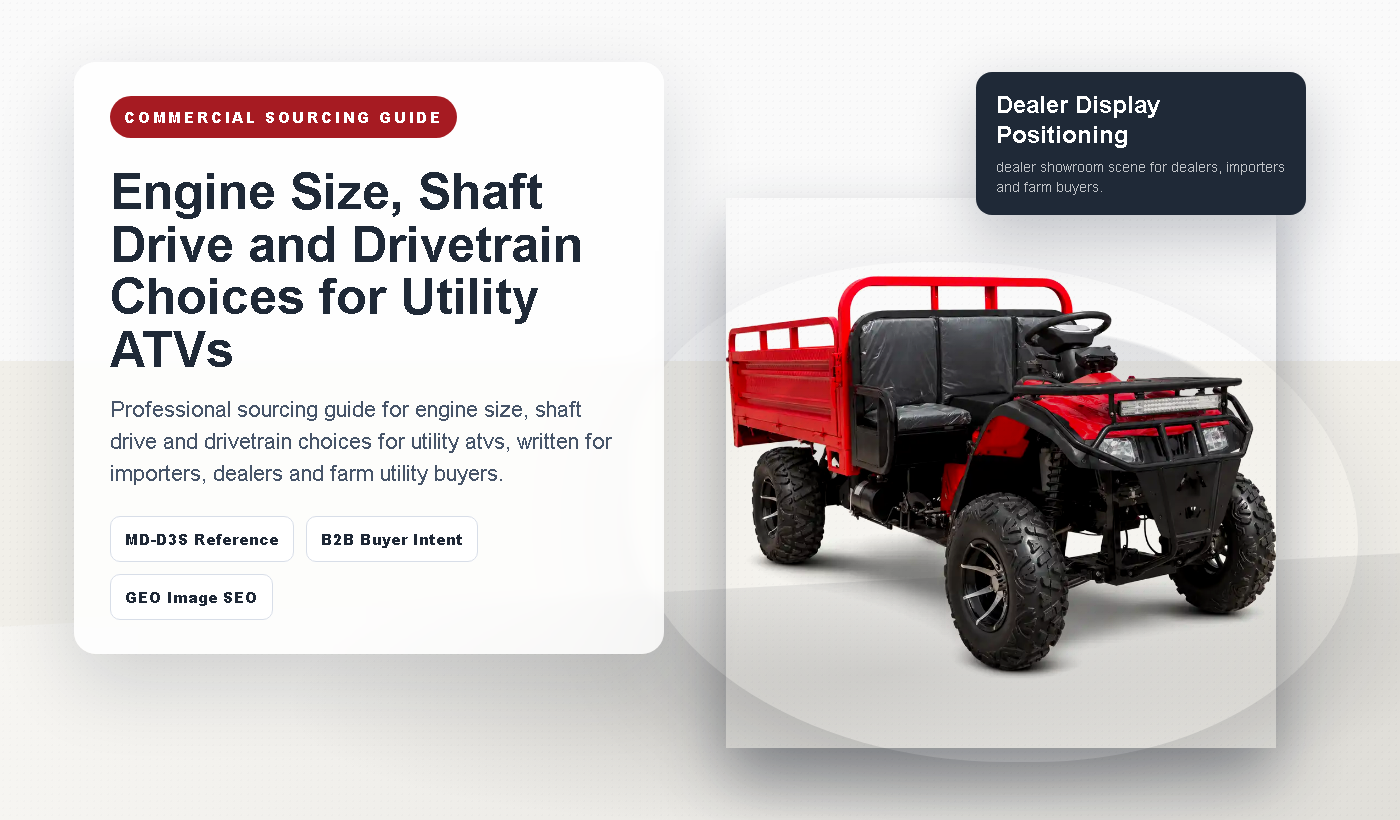
Gasoline ATV Engines and Drivetrains: Engine Size, Shaft Drive and More
For B2B buyers sourcing all-terrain vehicles for import, retail, rental, or agricultural distribution, the gasoline ATV engine is the single most consequential specification on a product data sheet. It determines top speed, torque delivery, fuel consumption, service intervals, and ultimately how a machine performs in the hands of an end customer. Choosing the wrong ATV engine size for a target market creates warranty claims, unhappy dealers, and slow-moving inventory. Choosing the right one builds a repeatable, profitable product line.
This guide is written for importers, dealers, and OEM sourcing teams who need to compare gasoline ATV powertrains across the full spectrum — from compact 125cc recreational models to 800cc workhorses — and decide which engine, transmission, and drive configuration to specify. We cover engine displacement bands and their real-world power bands, the two-stroke versus four-stroke trade-off, CVT and manual gearboxes, chain drive versus shaft drive maintenance economics, and two-wheel versus four-wheel drive systems. Use the comparison tables as a shortlist tool, then match each specification to the application you are actually selling into.
Why the Powertrain Decision Matters More Than Styling
Retail buyers often choose an ATV by looks and price. B2B buyers cannot afford that luxury. The powertrain dictates the cost structure of an entire product line: engine displacement drives landed cost, transmission choice affects parts stocking, and the final drive system determines how much workshop time a dealer spends on each unit across its service life. A fleet operator who buys 50 units with chain drive knows every machine will need chain adjustment and lubrication within the first months of service. The same fleet on a shaft drive ATV eliminates most of that recurring labour — a difference you can quantify per unit, per year, before you ever sign a purchase order.
There is also a regulatory dimension. Emission compliance for gasoline engines varies by destination market, and displacement often maps to homologation categories and registration classes. Confirm which engine size brackets your target countries recognise before you finalise a model range, and ask each supplier for the specific emissions documentation that applies to every configuration you shortlist.
Gasoline ATV Engine Sizes from 125cc to 800cc: Matching Displacement to Market
The sections below walk through the standard displacement bands used across the export market. Note that displacement alone does not define performance: valve configuration, carburetion versus electronic fuel injection, cooling method, and tuning all shift the power band. Use these bands as a starting framework, then compare dyno curves — the torque peak and where it arrives — between shortlisted models rather than comparing cubic centimetres alone.
125cc to 150cc: Entry-Level and Youth Models
Machines in this class typically produce 8 to 12 horsepower and are sold as youth models or lightweight utility runabouts, with top speeds in the 40 to 55 km/h range. Nearly all are air-cooled single-cylinder four-strokes — simple, cheap to service, and forgiving for first-time riders. For B2B buyers this band is a volume entry point in emerging markets where price sensitivity dominates and margins are thin, so freight weight and supplier quality consistency matter more than headline power figures. Most suppliers fit either a continuously variable transmission or a small manual gearbox with reverse; ask which one the model carries, because it changes the parts you will need to stock.
200cc to 300cc: The Utility Workhorse Band
Roughly 15 to 22 horsepower, with torque arriving low in the rev range, makes this the default band for farm chores, light hauling, trail recreation, and tour operations. Water-cooled versions hold up better under continuous load and in hot climates; air-cooled units are cheaper and simpler. This is the most competitive export band, and the one where specification sheets diverge most — identical displacement can hide very different frame geometry, suspension travel, and rack capacity. For dealers it is the backbone of the range; for rental operators it offers the best balance of durability, fuel economy, and rider accessibility.
400cc to 500cc: All-Round Performance and Heavy Utility
At 25 to 35 horsepower, this band tows 300 to 500 kg, cruises comfortably at higher speeds, and handles mixed terrain without strain. Selectable four-wheel drive and differential locks become standard here, along with heavier-duty axles and bigger brakes. B2B buyers targeting hilly orchards, ranches, hunting lodges, or tour fleets should treat this band as the default recommendation, because it covers the widest spread of commercial applications with one platform.
600cc to 800cc: Heavy-Duty and High-Performance
Top-end displacement delivers 40 to more than 70 horsepower, often from twin-cylinder engines, with large-capacity racks, winch-ready frames, and heavy-duty drivetrain components. Fuel consumption rises noticeably, and so does unit cost. Reserve this band for applications that genuinely need the torque — commercial snow removal, deep mud work, large-acreage farming — and match it to proven demand rather than aspiration, because higher price points mean slower inventory turnover and more working capital tied up in the container.
2-Stroke vs 4-Stroke Gasoline ATV Engines: Know the Trade-Off
Two-stroke engines are now a minority in the export ATV market, but they still appear in small utility and sport models. They produce more power per displacement, are lighter, and have fewer moving parts — but they burn a fuel-oil mixture, emit more smoke, and require more frequent top-end rebuilds. Four-stroke engines dominate modern line-ups: cleaner emissions, better fuel economy, longer service life, and smoother low-speed torque, at the cost of extra weight and a higher initial price.
For B2B buyers the decision is almost always four-stroke, for three reasons. Regulatory pressure on two-stroke emissions is rising across major markets. Service training for dealer networks is simpler when every model shares one technology. And end-customer expectations around noise, smell, and fuel cost increasingly favour four-stroke. Keep two-stroke only if you have a specific, proven demand segment — and require the supplier to document current emissions compliance for your destination market before you commit.
CVT Transmission or Manual Gearbox?
The continuously variable transmission, or CVT, is the default on nearly all modern gasoline ATVs. A belt-driven variator adjusts the effective gear ratio continuously, so the engine always runs near its most efficient speed and the rider simply presses the throttle — no clutch lever, no gear shifting. That makes CVT models dramatically easier to sell to recreational users and rental fleets, where rider skill varies enormously. The drive belt and centrifugal clutch typically need inspection every 1,000 to 2,000 km depending on load and terrain, and belts are inexpensive consumables with fast-moving demand in the aftermarket.
Manual gearboxes — usually four to six speeds, often with reverse — still appear on agricultural and export utility models. They give the operator direct gear selection for steady-speed work such as spraying, towing, or plowing, and some fleet managers prefer them for predictability and the absence of belt wear. The trade-off is a steeper learning curve for end users and higher parts complexity — clutch plates, cables, shift forks — for your spare-parts program. For most B2B ranges, CVT is the safer default, with manual available as a special-order option for farm-focused markets.
Chain Drive vs Shaft Drive: Which ATV Drivetrain Costs Less Over Time
Final drive is where two otherwise identical gasoline ATV models diverge most in long-term cost. The choice also shapes your aftermarket revenue, your service network's workload, and your customers' satisfaction.
Chain Drive
Chain-driven final drive is the industry standard on entry and mid-range models. An exposed chain and sprocket set requires regular lubrication, tension adjustment every few hundred kilometres, and replacement roughly every 2,000 to 4,000 km under normal use — and those intervals shrink dramatically in dusty or muddy conditions. Chains are inexpensive and universally available, which keeps parts costs low and service simple for any workshop. But the labour is recurring: every service visit is an opportunity for a dealer to build aftermarket revenue, or for an owner to skip maintenance and generate a complaint. For dealer networks that profit from service work, chain drive is a feature, not a flaw.
Shaft Drive
A shaft drive ATV replaces the chain with a sealed driveshaft and enclosed gearing at the wheel hub. It requires virtually no routine maintenance beyond periodic oil changes in the drive housing, and it shrugs off mud, water, and sand that would destroy a chain in weeks. That reliability is the single biggest practical selling point for commercial fleets, agricultural operators, and any buyer who cannot guarantee regular maintenance. The trade-offs are a higher upfront cost per unit, slightly higher drivetrain weight, and pricier, less universally stocked replacement parts — so confirm the supplier's spare-parts pipeline and typical lead times before committing a model to your range.
The Decision: Chain vs Shaft
Frame it as a total-cost-of-ownership trade. Chain drive minimizes purchase price and parts cost but adds recurring labour; shaft drive raises the initial price and absorbs the maintenance instead. Rental fleets and agricultural operators, who pay for every hour of downtime, usually choose shaft. Price-driven retail ranges usually stay on chain. The strongest B2B strategy is to offer both configurations in the same model family, so the application — not the showroom — decides.
| Factor | Chain drive | Shaft drive |
|---|---|---|
| Upfront cost | Lower | Higher |
| Routine maintenance | Frequent: lubrication, tensioning, replacement | Minimal: periodic drive-housing oil change |
| Typical replacement interval | 2,000 - 4,000 km | Years under normal use |
| Parts cost and availability | Low cost, widely stocked | Higher cost, confirm supplier pipeline |
| Best fit | Price-driven retail, dealer service revenue | Rental fleets, agriculture, harsh conditions |
2WD vs 4WD: Matching Traction to Terrain and Task
Two-wheel drive models drive the rear axle only: lighter, cheaper, more fuel-efficient, and perfectly adequate on hard, flat ground, light trails, and suburban duty. Four-wheel drive sends power to all four wheels, usually through a selectable system with a front differential lock for the toughest conditions. For B2B buyers, treat 4WD as mandatory for agricultural, forestry, mountainous, and serious rental applications; 2WD remains valid for flat-terrain utility, budget-oriented youth ranges, and markets where price is the deciding factor.
Be aware that 4WD adds weight, mechanical complexity, and cost — and that a poorly built 4WD system with weak CV axles can generate more warranty claims than a well-sorted 2WD. If you source 4WD, verify the supplier's history with that configuration, ask for field-failure rates, and stock the high-wear parts — CV joints, boots, and driveshaft components — before launch.
How to Match the Powertrain to the Application: A B2B Shortlist
- Define the terrain and duty cycle. Flat farmland points to 200cc - 300cc 2WD; mountains, mud, and snow point to 400cc+ 4WD. Estimate daily hours of operation — continuous load favours water-cooled engines.
- Profile the end user. Rental fleets and first-time buyers need CVT and forgiving power delivery; experienced farmers may prefer a manual gearbox with low-range capability.
- Choose a service strategy. If dealers profit from service work, chain drive generates workshop revenue. If your customer pays for downtime, shaft drive sells itself.
- Check regulatory brackets. Verify which displacement classes your destination countries register and tax, and request emissions documentation per configuration.
- Audit the spare-parts pipeline. Confirm stock availability and lead times for belts, chains, shafts, clutches, and pistons before placing a container order.
- Test with mixed containers. Most suppliers allow several configurations in one shipment — combine a proven volume model with one premium configuration to measure real demand before scaling.
| Displacement band | Typical power | Typical top speed | Best-fit applications | Market tier |
|---|---|---|---|---|
| 125cc - 150cc | 8 - 12 hp | 40 - 55 km/h | Youth models, first-time riders, light flat-terrain utility | Entry / volume |
| 200cc - 300cc | 15 - 22 hp | 60 - 80 km/h | Farm chores, light hauling, trails, rental fleets | Mid / workhorse |
| 400cc - 500cc | 25 - 35 hp | 80 - 100 km/h | Mixed terrain, towing, ranches, tour operations | Mid-premium |
| 600cc - 800cc | 40 - 70+ hp | 100+ km/h | Heavy utility, snow removal, high-performance recreation | Premium |
FAQ: Gasoline ATV Engine and Drivetrain Questions
What gasoline ATV engine size should a dealer stock first?
For a general-purpose range, start with the 200cc to 300cc band. It covers the widest spread of utility and recreational applications, keeps landed cost manageable, and is the most liquid segment in most export markets. Add a 125cc to 150cc youth model for volume and a 400cc to 500cc 4WD unit for commercial buyers once the core line is selling.
Is a shaft drive ATV worth the higher unit cost?
For commercial fleets, agricultural operators, and rental businesses, usually yes. Estimate the labour a chain system requires per unit per year — lubrication, tensioning, and replacement — and compare it with the shaft's upfront premium. In dusty or muddy conditions the gap widens quickly, and reduced downtime often pays for the difference within the first service season.
How often does a chain-driven ATV need maintenance?
As a general rule, lubrication every few rides, tension checks every 300 to 500 km, and replacement every 2,000 to 4,000 km under normal conditions. Heavy loads, sand, mud, and water shorten those intervals substantially. Quote these figures to your dealers so they can build service reminders into their sales process.
Are two-stroke ATVs still worth sourcing?
Only for a specific, proven demand segment. Two-stroke units are lighter and cheaper to build, but emissions rules are tightening in most major markets and end users increasingly reject the smoke, noise, and oil mixing. If you do source them, demand written emissions documentation and confirm which destinations still accept the configuration.
What is a typical export lead time for a gasoline ATV container order?
Most suppliers quote roughly 30 to 60 days for standard configurations in production, and 60 to 90 days or more for custom colours, decals, or drivetrain changes. Always request a written production schedule with milestone dates in the purchase order, and factor in sea freight time for your destination port.
Can one container mix engine sizes and drivetrains?
Yes — most export suppliers allow mixed configurations within a single shipment, though they may apply a minimum quantity per model. Mixing a proven volume model with one premium configuration, such as a shaft drive variant, is a low-risk way to test demand before committing to a full model line.